

Realised vs Unrealised Capital Gains: How Capital Gains Tax Really Works in Australia
There is a specific kind of thrill that comes with checking your investment portfolio or seeing a revised valuation of your family home. In Australia, we are a nation obsessed with property and market movements; it’s the “barbecue conversation” of choice. You see the numbers climb, and suddenly, you feel significantly wealthier. But there is a silent distinction sitting in your ledger that separates “paper wealth” from “spendable cash.”
Understanding the nuances of unrealised vs realised capital gains is more than just an accounting exercise; it is the foundation of building a long-term wealth strategy. In the Australian tax landscape, knowing how capital gains tax works can be the difference between a flourishing portfolio and a surprise bill from the Australian Taxation Office (ATO).
Let’s break down the mechanics of capital gains tax in Australia, explore why your “paper profits” aren’t taxed yet, and explain exactly what unrealised capital gains tax is in the context of our current economic climate.
The Psychology of the “Paper Gain”
Before we dive into the tax law, we have to look at the macro picture. Australians are currently sitting on a mountain of wealth that exists almost entirely on paper. According to the latest release from the Australian Bureau of Statistics (ABS), household wealth recently increased by approximately 3.1% to a staggering $18.4 trillion.
Most of this growth wasn’t because people earned higher salaries; it was because the assets they already owned became more valuable. This is the essence of Unrealised Capital Gains. When your superannuation balance climbs due to market performance or your investment property in Brisbane or Sydney is valued higher than last year, you have an unrealised capital gain.
As ABC News reported on recent ABS data, residential land and dwellings have been the largest contributors to this wealth surge. This creates a “wealth effect”, when people feel richer because their assets have appreciated, they tend to spend more, even if they haven’t sold a single share or brick. However, from a tax perspective, these gains remain “invisible” until a specific moment occurs.
What is Unrealised Capital Gains Tax?
A common question for new investors is: What is unrealised capital gains tax, and do I have to pay it every year?
In Australia, the simple answer is: you don’t. Unlike some proposed “wealth taxes” discussed in global politics, the capital gains tax in Australia is not a tax on the value you hold; it is a tax on the profit you lock in.
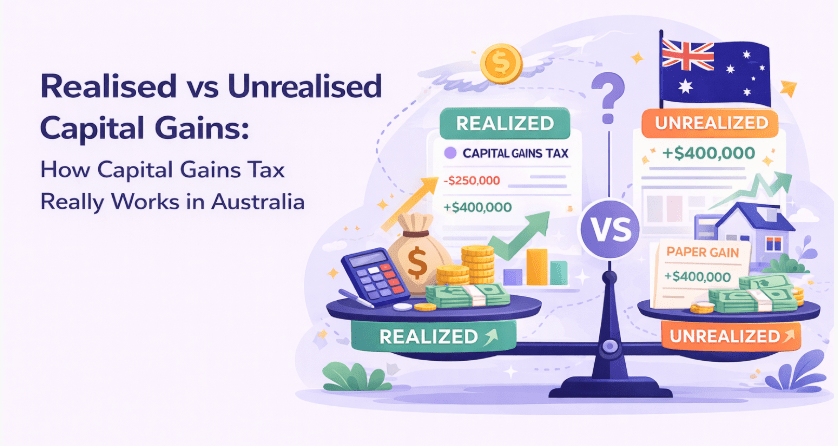
Unrealised Capital Gains refer to the increase in the value of an asset that you still own. For example, if you bought $10,000 worth of shares and they are now worth $15,000, you have an unrealised gain of $5,000. Because you haven’t sold the shares, that $5,000 isn’t “real” in the eyes of the tax man yet. You cannot spend it at the grocery store, and the ATO cannot tax it.
The Reserve Bank of Australia (RBA) has noted that housing wealth is a primary driver of these swings in household net wealth. For many Australians, Unrealised Capital Gains represent the majority of their net worth. This is a “tax-free” growth phase where your investments can compound without being eroded by annual taxation.
The Trigger: Transitioning to Realised Capital Gains
The landscape changes the moment you decide to sell. This transition from unrealised vs realised capital gains is known as a “CGT event (Capital Gains Tax).”
Realised capital gains occur when you dispose of an asset—whether through a sale, a gift, or a transfer—for more than it cost you to acquire it. At this point, the “paper profit” becomes a legal financial gain that must be reported on your annual tax return.
This is where the narrative of “feeling rich” meets the reality of how capital gains tax works. Once a gain is understood, it is added to your assessable income for that financial year. If you are in a high-income bracket, a large realised capital gain could potentially push you into the highest marginal tax rate (45% plus the Medicare Levy).
How Capital Gains Tax Works: The Mechanics
So, how is the actual bill calculated? Capital gains tax in Australia isn’t actually a separate tax; it is part of your income tax.
When you move from Unrealised Capital Gains to realised capital gains, you calculate your “cost base” (what you paid for the asset plus certain costs like stamp duty and legal fees) and subtract it from the sale price. The remaining amount is your capital gain.
However, Australia offers a significant incentive for long-term investors. According to the ATO’s guidance on the CGT discount, if you hold an asset for at least 12 months before selling, you may be eligible for a discount:
- Individuals and Trusts: Can generally reduce their realised capital gains by 50%.
- Complying Super Funds: Receive a 33.33% discount.
- Companies: Are not eligible for the discount and pay the full corporate tax rate on the gain.
The Australian Treasury’s 2024–25 Tax Expenditures and Insights Statement reveals the scale of this system. Over 1.5 million individual tax filers reported a net capital gain in the 2021–22 financial year, with around two-thirds of those benefiting from the CGT discount. This mechanism is designed to encourage Australians to hold assets longer, moving wealth into the Unrealised Capital Gains category for extended periods.
The Strategic Value of Unrealised Capital Gains
The primary advantage of Unrealised Capital Gains is “tax deferral.” By keeping a gain unrealised, you are essentially receiving an interest-free loan from the government. Instead of paying 25% or 45% of your profit in tax today, that money stays invested, earning more returns, potentially for decades.
This is why timing the move to realised capital gains is a critical part of financial planning. Many savvy investors wait until they have retired or are in a lower-income year to “crystallise” their gains. By doing so, they ensure that even after the 50% discount, the remaining gain is taxed at a lower marginal rate.
The Equity Debate: Who Benefits Most?
There is significant debate across the country regarding how these tax benefits are actually distributed. Insights from Austaxpolicy (Tax and Transfer Policy Institute) suggest that the 50% discount may be more of a “policy oversight” than a perfectly balanced incentive.
The research suggests that older, wealthier Australians are more likely to hold assets with significant Unrealised Capital Gains and are more strategic about when they choose to realise them. This has led to policy discussions in the Senate Economics References Committee about whether the current CGT settings encourage “overinvestment” in housing at the expense of other sectors.
Furthermore, the Parliamentary Budget Office (PBO) has highlighted the fiscal cost of these settings, noting that the combination of negative gearing and CGT discounts will cost the Federal Budget billions over the next decade.
Navigating Unrealised vs Realised Capital Gains
Understanding how capital gains tax works is the key to mastering your financial future. While it is exciting to see your Unrealised Capital Gains grow on your portfolio dashboard, it is vital to remember that these gains are “gross”—they don’t account for the tax liability that will eventually come due.
To manage your wealth effectively in Australia, keep these three principles in mind:
- Respect the 12-Month Rule: Never realise a gain at 11 months if you can wait until 12. That 50% discount is the most powerful tool in the capital gains tax Australia toolkit.
- Strategise the Realisation: Don’t sell just because the market is high. Consider your total income for the year. Could you wait for a year when your other income is lower?
- Know Your Cost Base: Keep meticulous records of every expense related to your assets. A higher cost base means a lower realised capital gain, which means more money in your pocket.
Wealth in Australia is often built in the “unrealised” phase—through patience, market growth, and the compounding of value. However, wealth is protected in the “realised” phase through smart tax planning and a clear understanding of the rules.
At Efficient Capital, we help investors navigate these complexities, ensuring that when you do decide to turn those paper profits into reality, you do so in the most tax-efficient way possible. Whether you are looking at shares, property, or complex trust structures, understanding unrealised vs realised capital gains is the first step toward a more secure financial legacy.