

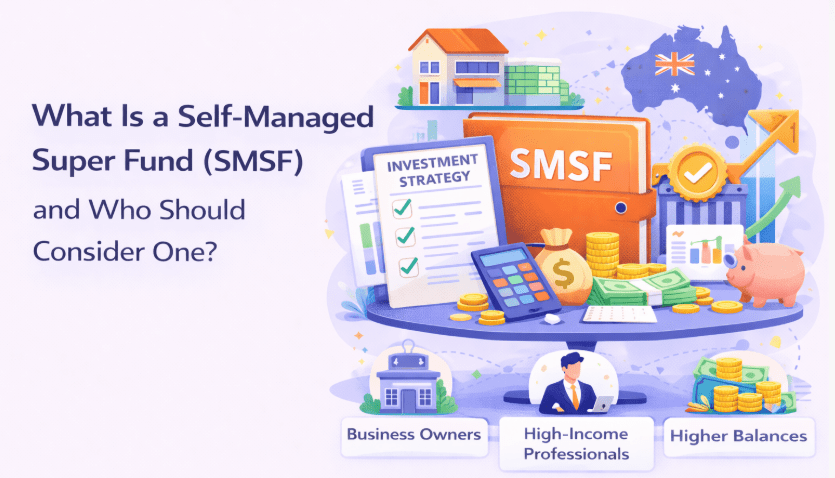
What Is a Self-Managed Super Fund (SMSF) and Who Should Consider One?
A Self-Managed Super Fund (SMSF) is a private super fund designed for a small group. It usually can consist up to six people. The members of the fund also take on the role of trustees, which means they are directly responsible for how the super is invested and managed.
This structure is available to any Australian who meets the eligibility requirements, but it is most commonly considered by business owners and higher-income professionals. Basically, people who want more say in how their super is used. In practice, SMSFs are often explored when people are dealing with larger balances and business assets. Even for property decisions that do not sit neatly inside standard super funds.
Think of super like owning an investment property. With most retail or industry funds, a manager handles everything. They decide where the money goes and send you updates from time to time. You stay hands-off. With a Self-Managed Super Fund (SMSF), you are managing the property yourself. You choose what to invest in and when changes are made. The upside is flexibility. The downside is that you are also the one responsible for getting things right and keeping records in order.
The growing interest makes it worth slowing down and looking at what an SMSF actually involves beyond the headline idea of control.
Why More Australians Are Making the Switch
The shift toward self-management is usually sparked by a moment of realization: that your super doesn’t have to be a “black box” managed by a faceless entity. People start asking questions about tax perks, whether they can buy their office space through their fund, or if they can have more transparency. That’s usually the moment when what is an SMSF shifts from a piece of financial jargon to a genuine lightbulb moment.
The numbers back this up. We aren’t looking at a niche hobby anymore; with over 638,000 funds holding a cool $1.02 trillion in assets, this is a massive pillar of the Australian economy. This growth suggests that Australians are becoming more deliberate with their wealth. They want to know how an SMSF works because they want their retirement strategy to actually mirror their business life as active, calculated, and rewarding.
Getting to the Grit: What is the SMSF Meaning?
If you ask ten people for the SMSF meaning, nine will probably say “it’s just managing your own super.” While that’s true on the surface, the reality is a bit more hands-on. Think of an SMSF as a private, legal “trust” where you wear two hats: you’re the member (the person getting the money later) and the trustee (the person responsible for the rules now).
It’s helpful to view it like running a small company. You wouldn’t run a business without a clear plan, and you can’t run a Self-Managed Super Fund (SMSF) without one either. You get the keys to the kingdom, meaning you can invest in things a standard industry fund wouldn’t touch. Think of it like a commercial warehouse or a medical suite, but you also have to keep the books spotless.
Nothing happens by accident here. You need a documented investment strategy and a commitment to annual audits. This level of control is exactly why we see so much uptake in SMSF for professionals; if you’re already used to navigating the complexities of a professional practice or a business, the compliance side of an SMSF feels like a natural extension rather than a chore.
Moving from Theory to Reality: How Does an SMSF Work?
Understanding how does an SMSF work in the real world comes down to one word: balance. You’ve got the flexibility to pivot your investments based on market shifts, but you’re also under a microscope. The ATO doesn’t mind you being creative with your investments, provided you aren’t using the fund as a personal piggy bank or a way to help out a struggling mate.
For many, the real win is using the fund to secure the future of their business. By financing a commercial property through the fund, you aren’t just paying rent to a stranger anymore; you’re paying it to your future self. It’s a powerful cycle, but it only works if you’re willing to respect the boundaries the law puts in place.
To further understand how an SMSF works, you have to view it as a small business where the “product” is your retirement nest egg.
- The Structure: An SMSF can have up to six members. These are often family members or business partners.
- The Responsibility: As a trustee, you must create an investment strategy, maintain accurate records, and arrange an annual audit by an approved SMSF auditor.
- The Assets: Recent ATO statistics show that SMSF investors are highly tactical. As of December 2024, direct property accounted for $168 billion (16.5%) of total assets, while cash holdings reached a record $161.4 billion.
- Compliance: This is the “heavy lifting” part of the fund. You must ensure all investments are made at “arm’s length” and solely for the purpose of providing retirement benefits.
While these rules form the operational backbone of your fund, the real excitement for most Australians lies in the unique growth opportunities that this level of control unlocks.
Why the Sector is Booming
The surge in SMSFs isn’t just a ripple; it’s a wave. Over the five years leading into 2025, we’ve seen an average of 31,200 new funds pop up every year, with total assets growing by nearly 48%.
Why the rush? It’s a mix of younger professionals (the median age for new funds is now around 46) and a general frustration with the “one-size-fits-all” model of larger funds. People want a retirement plan that actually accounts for their specific tax bracket and estate planning needs, rather than just being another number in a pool of millions.
SMSF for Professionals: The Strategic “Power Move”
For high-earning individuals like the doctors, lawyers, and engineers of Australia, a Self-Managed Super Fund (SMSF) often stops being a “savings account” and starts being a sophisticated financial engine.
The “Medical Suite” Strategy
Let’s look at a practical example we see often. Imagine a specialist physician currently paying $100,000 in annual rent to a landlord. That’s $100,000 leaving the business forever. By using an SMSF, that doctor could potentially purchase their own clinical rooms and lease them back to their practice.
- The Math: The doctor’s practice pays $100,000 in rent to their own SMSF. That rent is a tax-deductible expense for the business (saving up to 47% in tax). Inside the SMSF, that same income is taxed at only 15%.
- The Result: You’re looking at a net annual saving of roughly $32,000. Plus, when it’s time to retire and sell the practice, the doctor still owns the building, providing a steady stream of rental income for life.
This is where specialised commercial financing changes the game, turning a boring overhead into a massive wealth-builder.
Financing: The Role of LRBAs
One of the most powerful and misunderstood parts of how does an SMSF work is borrowing. You can actually take out a loan within your super to buy property. This is called a Limited Recourse Borrowing Arrangement (LRBA).
Essentially, the loan is “quarantined” to that one asset. If things go south, the lender can’t touch the rest of your super balance. It’s a great way to leverage your way into a commercial property, but because the rules are so tight, you need to ensure the loan is structured perfectly to avoid any issues with the ATO.
The Risks: Where People Get It Wrong
We have to be real here: the ATO is not a silent partner. They are watching. Recent data shows a 3 to 4% breach rate in the sector, with nearly $481.8 million flagged in illegal early access. The most common traps could be:
- Treating super like a bank: You cannot “borrow” $10k for a holiday and plan to pay it back later. That’s a massive red flag.
- Business “propping”: You can’t use your SMSF to bail out your business if cash flow gets tight.
- Bad record-keeping: If you aren’t organized, the audit fees alone will eat your returns.
While these red flags might seem daunting, they shouldn’t discourage you; they simply highlight why having a clear strategy and the right professional guidance is the non-negotiable price of entry for a successful fund.
Who is This Actually For?
An SMSF is a powerful tool, but it’s not for everyone. You should probably stick to a standard fund unless:
- Your balance is healthy: You generally need at least $200,000 to $250,000 to make the annual operating costs worth it.
- You want the premises: If you want to own the roof over your business’s head, an SMSF is your best bet.
- You’re a “details” person: You need to be willing to engage with your accountant and stay on top of the rules.
Ultimately, if you have the balance to support the costs and the drive to manage your own financial destiny, the next logical step is to see how this structure can be put into practice to build lasting wealth.
Is an SMSF Your Next Power Move?
At the end of the day, a Self-Managed Super Fund (SMSF) is about one thing: choice. It’s the choice to stop wondering what’s happening with your money and start deciding. Whether you’re looking to finance a new office or just want more transparency in your investments, the shift to an SMSF can be the most profitable decision you make.