

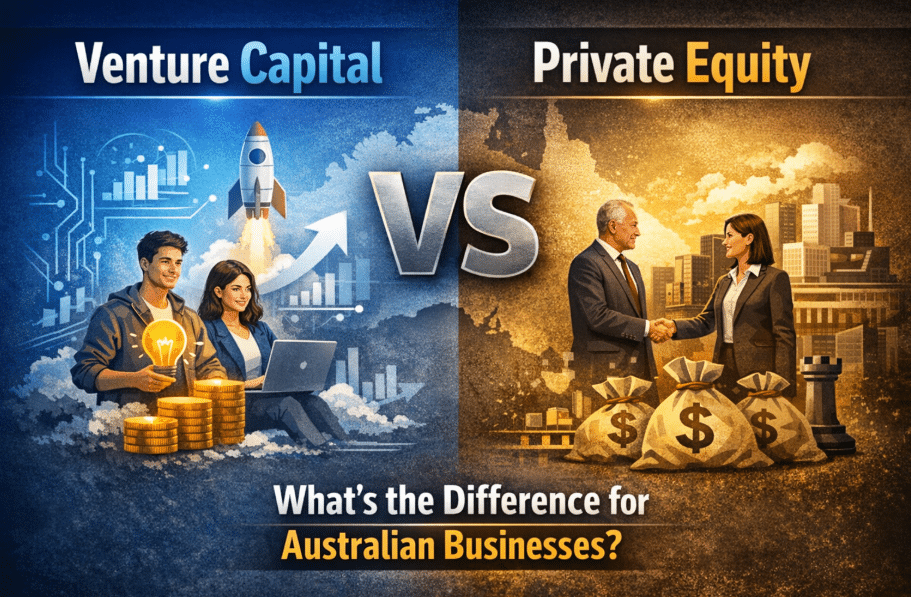
Venture Capital vs Private Equity: What’s the Difference for Australian Businesses?
Spend enough time around Australian founders or business owners, and the same two funding terms keep appearing in conversation: venture capital and private equity.
They often get mentioned together, especially when companies start thinking seriously about growth. A business reaches a point where internal revenue is no longer enough to fund the next stage, and outside investment starts entering the discussion.
At that moment, the terminology can become confusing. The words sound similar, yet they refer to very different types of investment and usually appear at different stages of a company’s journey.
Understanding venture capital vs private equity helps bring some clarity to that conversation. The two funding models operate in distinct ways, and the right choice often depends on where a business currently stands and where it wants to go next. Before exploring which path may suit a business, it helps to understand how each type of investment typically works in practice.
What Is Venture Capital?
When people talk about startup funding, venture capital is usually the first thing that comes up.
At its core, venture capital is money invested in young companies that are still figuring things out. The product may still be evolving. The business model may not be fully proven yet. What investors see instead is the possibility that the company could grow very quickly if everything goes right.
Because of that uncertainty, venture capital funding is often associated with higher risk. Investors know that some startups will fail. The ones that succeed, however, can grow large enough to compensate for those losses.
Most businesses raising venture capital are still in the early stages of building their company. They may be refining their product, hiring their first senior team members, or expanding into new markets sooner than their cash flow would normally allow.
A few common features tend to appear in venture capital deals:
- Investors usually take a minority ownership stake
- The company is still in a high-growth phase
- Capital is used to accelerate product development or expansion
- Returns depend heavily on future growth potential
In Australia, venture capital has become closely tied to the technology sector. Some of the country’s most recognised success stories started with venture backing. Companies like Canva, Airwallex, and Atlassian began as ambitious startups before growing into globally recognised businesses.
For founders, the biggest appeal of venture capital funding is momentum. Instead of relying solely on revenue to grow, outside investment allows startups to move faster. Teams can hire earlier, build products more quickly, and enter new markets before competitors catch up. That speed can make an enormous difference in industries where timing matters.
What Is Private Equity?
Not every business seeking investment is a startup. Some companies are already profitable. They may have been operating for years, built a loyal customer base, and reached a point where the next stage of growth requires serious capital. This is typically where private equity investors appear.
Instead of funding experiments or early ideas, private equity firms usually look for businesses that are already functioning well but could grow further with the right backing.
The investment is often larger than what early-stage startups receive. In many cases, the investor acquires a meaningful ownership stake and becomes closely involved in strategic decisions. You will usually see private equity in situations where a company wants to:
- Expand into new regions
- Acquire other businesses
- Upgrade systems or infrastructure
- Prepare the company for a future sale
For many Australian businesses, this stage arrives after the early growth phase. The company is stable, but scaling further requires capital, expertise, and sometimes structural changes. That is why private equity investors often work alongside management teams rather than simply providing funding. Their role may include improving operations, refining strategy, and positioning the business for its next phase of expansion.
Across Australia, these investments regularly appear in sectors such as healthcare, infrastructure, technology, and professional services.
Venture Capital vs Private Equity: The Core Differences
Understanding venture capital vs private equity becomes easier when you compare them across key factors.
Factor |
Venture Capital |
Private Equity |
| Business stage | Early | Mature |
| Risk level | High | Moderate |
| Investment size | Smaller | Larger |
| Ownership | Minority stake | Often majority |
| Focus | Innovation | Efficiency & scaling |
The most important distinction in venture capital vs private equity is the stage of the business. Venture capital supports companies that are still proving their model. Private equity supports companies that already have one. This difference explains why the two funding models often operate in different parts of the business lifecycle.
Why Venture Capital Funding Is Growing in Australia
Over the past decade, Australia’s startup scene has started to look very different from what it once was. New technology companies are appearing more frequently, and investors are paying closer attention.
That shift is visible in venture capital funding. In 2025 alone, Australian startups raised about $5.1 billion across 390 deals, with a noticeable share of that capital flowing into artificial intelligence companies. More than $1 billion went specifically into AI-focused startups.
The distribution of that funding has not been even. A smaller group of large deals has captured a significant portion of total investment, especially in sectors like fintech, AI, and climate technology. Taken together, these patterns suggest that venture capital investors are becoming more confident about the long-term potential of Australian startups.
Why Private Equity Continues to Expand
In Australia, private equity is often involved when established businesses look for new capital to grow. These investments usually happen after a company already has steady revenue and a working business model. In recent years, several deals have been very large. Companies may use this type of investment to expand into new markets, acquire other businesses, or upgrade operations. For many firms, private equity becomes relevant once growth opportunities start requiring more capital than internal revenue can provide.
When Venture Capital Makes Sense
A company usually starts considering venture capital when growth opportunities begin to appear faster than the business can fund them on its own. This often happens with startups building new products or entering competitive technology markets. Instead of waiting for revenue to slowly support expansion, founders may raise venture capital funding to hire teams, improve the product, or move into new markets earlier. At that stage, the focus is usually on growing quickly rather than generating immediate profit.
When Private Equity May Be the Better Fit
Some businesses reach a point where the model already works. Revenue is steady, and the company understands its market. What it may need next is capital to grow further. This is where private equity can become relevant. The funding might support expansion, acquisitions, or a change in ownership. Compared with venture capital, which is often linked to younger startups, private equity tends to appear later in a company’s growth journey.
Beyond Venture Capital and Private Equity: Structuring the Right Capital Mix
Although discussions often frame venture capital vs private equity as a simple choice, the reality is more complex. Many successful businesses combine several types of funding over time.
A venture-backed startup might eventually work with private equity investors once it becomes profitable. Established companies supported by private equity may still rely on debt financing to fund acquisitions or infrastructure.
This is where financial structuring becomes important. Advisory firms such as Efficient Capital help businesses evaluate financing options that sit alongside equity investment. Even companies with strong investors often require working capital facilities, commercial lending, or strategic funding solutions to support expansion.
Understanding how different forms of capital interact can make a significant difference to long-term financial stability.
Choosing the Right Path for Growth
The debate around venture capital vs private equity is not about which model is better. It is about understanding which one fits your company’s stage and ambitions.
Venture capital is designed for companies that want to grow quickly and build new markets.
Private equity focuses on strengthening and expanding businesses that already have an established foundation.
As Australia’s innovation ecosystem continues to grow, both forms of capital will remain central to how businesses scale. For founders and business owners, the key is not just raising capital, but structuring it wisely. Understanding the differences between venture capital, venture capital funding, and private equity is the first step toward making the right financial decisions for your business.