

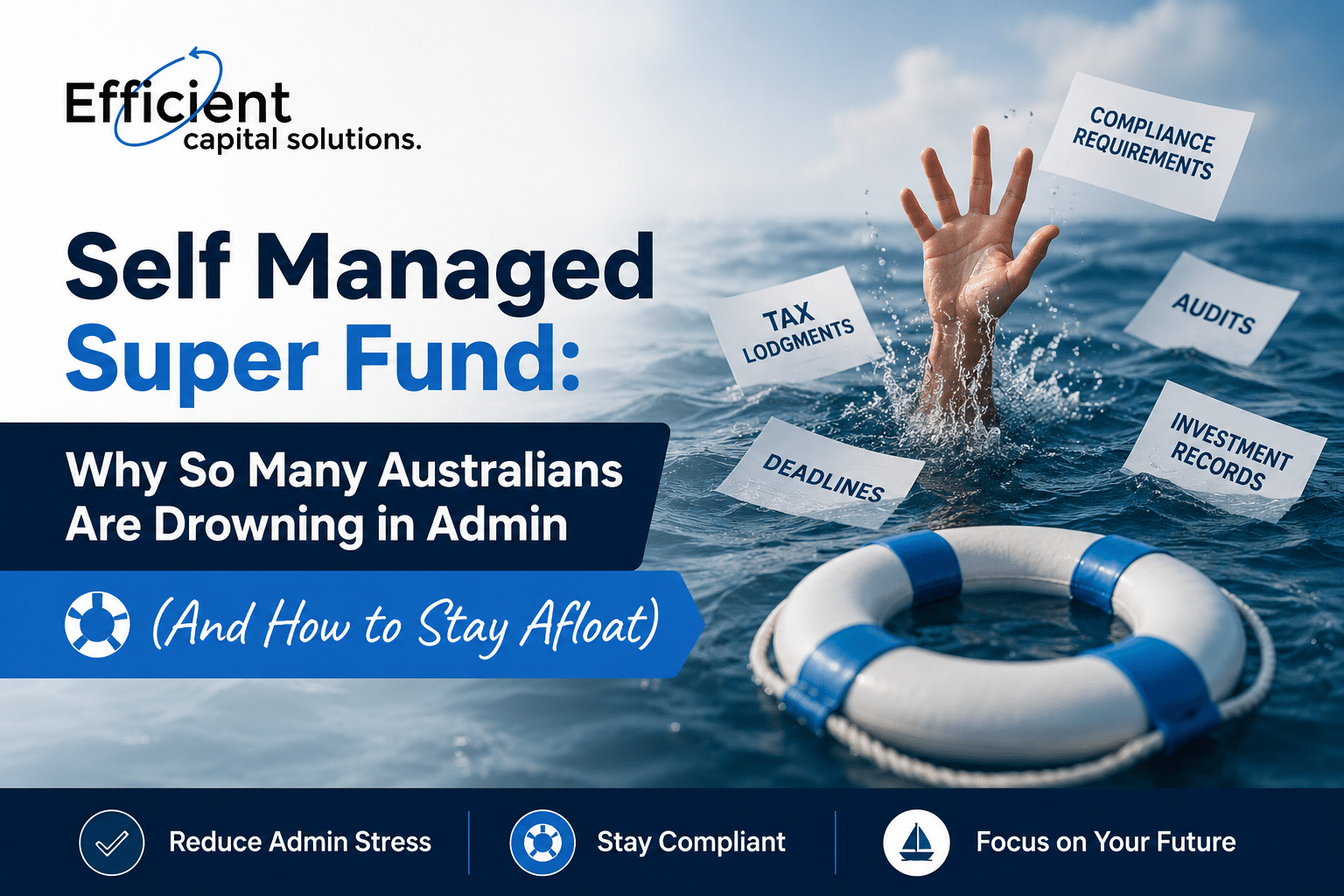
Self Managed Super Fund: Why So Many Australians Are Drowning in Admin And How to Stay Afloat
Self managed super funds are having a moment. According to the ATO’s most recent quarterly statistics, Australia now has more than 670,000 SMSFs holding over $1 trillion in assets, with quarterly establishment numbers repeatedly breaking records through 2025 and into 2026. Billions of dollars are flowing out of industry and retail super funds every year as Australians decide they’d rather manage their own retirement savings than leave it to a fund manager they’ve never met.
It’s easy to see the appeal. A self managed super fund hands you direct control over where your retirement money goes — property, direct shares, term deposits, even niche assets that big funds won’t touch. For people who like to be hands-on with their finances, that control is genuinely valuable.
But here’s what the glossy explainer articles tend to skip over: running a self managed super fund is a job. Not a “check in once a year” job — an ongoing administrative commitment with real legal weight behind it. Recent industry research backs this up directly, with newly established trustees citing keeping up with regulatory changes and paperwork as the single biggest challenge of running a fund. The same research found that almost half of newly established SMSFs now lean on a digital or specialist admin provider just to keep up.
This article is for anyone who’s either running an SMSF already and feeling buried, or considering setting one up and wanting the honest picture before they commit. We’ll cover what a self managed super fund actually is, why the administrative burden is so much heavier than people expect, the specific pain points trustees report most often, and — importantly — how to manage that burden without giving up the control that made you want an SMSF in the first place.
What Is a Self Managed Super Fund?
A self managed super fund (SMSF) is a private superannuation fund that you run yourself, rather than having an industry or retail fund manage it on your behalf. Structurally, it’s still superannuation — contributions go in, investments grow inside the fund, and money comes out as a pension or lump sum at retirement, subject to the same general rules that apply to any super fund.
The difference is who’s in the driver’s seat. With a self managed super fund, you (and any other members, since SMSFs can have up to six members) are also the trustees. That means you make the investment decisions, and you’re legally responsible for ensuring the fund complies with superannuation law.
This single fact — that members and trustees are the same people — is the root of almost every pain point we’re about to discuss. In a retail or industry fund, a team of professionals handles compliance, auditing, reporting, and investment governance, and the cost is bundled into your fees. In a self managed superannuation fund, that team is you, unless you choose to outsource pieces of it.
What Is a Self Managed Super Fund Used For? The Appeal in Plain Terms
Before getting into the harder parts, it’s worth being clear about why self managed super funds Australia-wide have grown so quickly, because the appeal is real and the trend isn’t slowing down.
Trustees commonly set up an SMSF to:
- Invest directly in residential or commercial property, including (under strict conditions) using the fund to support a related business’s premises
- Hold direct shares, ETFs, or other listed assets with full visibility over fees and performance, rather than a pooled, opaque fee structure
- Access asset classes that large APRA-regulated funds typically avoid, including direct property and, increasingly, digital assets
- Combine super balances across a couple or family group into a single, larger pool with shared strategy
- Build a more tailored estate planning and pension strategy around their specific retirement goals
Recent ATO data shows new SMSF trustees are getting younger — the largest single cohort of new establishments is now the 35–44 age group, a marked shift from the older trustee population that has historically dominated the sector. Vanguard’s most recent SMSF Investor Report also found the average decision-making new trustee is 44, with newer funds tending to start on smaller balances than in previous years.
None of that appeal disappears once you understand the admin side. But it does mean trustees increasingly need a realistic plan for handling the workload, rather than assuming it’ll be manageable because everyone else seems to be doing it.
The Real Pain Point: The Administrative Burden Nobody Mentions in the Pitch
If you ask current trustees what’s hardest about running a self managed superannuation fund, the answer isn’t investment selection. It’s the unglamorous, ongoing compliance machinery sitting underneath every decision you make. Here’s what that actually involves.
Annual Independent Audits
Every SMSF must be audited annually by an ASIC-registered approved SMSF auditor, independent of whoever prepares your fund’s accounts. This isn’t optional and isn’t a formality — auditors check both the financial accounts and your compliance with superannuation law, and they’re required to report certain contraventions directly to the ATO. Arranging this audit, supplying the right documentation, and resolving any findings adds a yearly cycle of work and cost that retail and industry fund members simply never see.
Ongoing Reporting and Tax Lodgement
Your self managed super fund needs its own annual return lodged with the ATO, which combines income tax, member contributions reporting, and regulatory information into a single document. Getting this right requires accurate, up-to-date records of every transaction, contribution, and investment movement throughout the year — not a once-a-year scramble, but continuous bookkeeping discipline.
Maintaining and Reviewing an Investment Strategy
Trustees are legally required to formulate, regularly review, and give effect to a written investment strategy that considers the fund’s risk, diversification, liquidity, and ability to pay benefits as members retire. This isn’t a “set and forget” document — regulatory guidance expects it to be revisited as circumstances change, and an outdated investment strategy is a common audit flag.
Keeping Up With a Moving Regulatory Target
Superannuation law doesn’t stand still. Contribution caps, pension drawdown rules, transfer balance caps, and compliance obligations are reviewed and adjusted regularly, and trustees are expected to know about and respond to changes as they happen. This is precisely the challenge that recent industry surveys flag as the single biggest pain point for newly established SMSF trustees — more so than picking investments.
Record-Keeping That Has to Survive Scrutiny
SMSF trustees are required to keep detailed records — minutes of trustee decisions, contracts, asset valuations, contribution documentation — for periods that can stretch to a decade or more, depending on the document type. When an audit or an ATO review happens, the burden of proof sits with the trustee.
Contribution Tracking and Cap Management
Every contribution into the fund — whether it’s a personal top-up, an employer contribution, or a transfer from another fund — needs to be tracked against annual contribution caps. Exceeding a cap, even unintentionally, can trigger additional tax and require corrective action, which means trustees effectively need a running tally of contributions throughout the year rather than checking once at tax time.
Pension Phase Adds Another Layer
Once a member moves into pension phase, the administrative load increases rather than easing off. Trustees must calculate and pay minimum (and, where relevant, maximum) pension drawdowns correctly each year, track the transfer balance cap for that member, and ensure the fund’s records reflect the change in tax treatment between accumulation and pension assets. Getting any of this wrong can have tax consequences that are difficult to unwind retroactively.
The Compounding Effect of “Just One More Thing”
Individually, each of these obligations might sound manageable. The real burden is cumulative: an annual audit, a tax return, a reviewed investment strategy, ongoing bookkeeping, contribution tracking, pension administration, and constant regulatory monitoring, all running in parallel, all with consequences for getting it wrong. Industry data backs up just how heavy this gets in practice — the average SMSF carries roughly $7,400 a year in administration and operating costs, covering audit fees, management expenses, and the ATO supervisory levy alone, before factoring in the trustee’s own time.
It’s no surprise, then, that nearly half of newly established SMSFs are now turning to specialist digital admin providers rather than trying to manage everything manually. The DIY appeal of an SMSF often collides with the reality that “self managed” doesn’t mean “solo” — most successful trustees build a support team around them, treating administration as a function to be resourced properly rather than squeezed into spare evenings and weekends.
The Compliance Risk Behind the Admin Burden
It’s worth being direct about what’s at stake if the administrative side slips. Non-compliance with superannuation law can result in the fund losing its complying status, financial penalties for trustees, and in serious cases, the fund’s assets being taxed at the top marginal rate rather than the concessional rate super is designed to enjoy. Auditors are obligated to report certain breaches to the regulator, which means small oversights — a late investment strategy update, mixing personal and fund assets, missing a lodgement deadline — don’t stay invisible.
2026 tax update: From 1 July 2026, Division 296 applies an additional 15% tax to the earnings attributable to the portion of an individual’s total superannuation balance above $3 million (on a realised-earnings basis; unrealised gains are not taxed). High-balance trustees should factor this in.
This is the part of the self managed super fund pitch that often gets glossed over by enthusiastic explainer content. The flexibility and control are genuine, but they come bundled with personal legal responsibility that doesn’t exist in the same way for members of retail or industry funds.
How to Manage the Administrative Burden Without Losing the Benefits of an SMSF
The good news is that the administrative weight of a self managed super fund is a known, well-mapped problem, and there are established ways to carry it without burning out or risking compliance breaches.
Build a Professional Team Early, Not After a Problem Arises
Most experienced trustees don’t go it entirely alone. A typical support team includes an SMSF accountant for ongoing bookkeeping and the annual return, an independent SMSF auditor (which is a legal requirement regardless), and often a financial adviser or broker for strategy and lending decisions. Treating these as “set up once” relationships rather than reactive, problem-driven engagements tends to produce far fewer compliance surprises.
Use Specialist SMSF Administration Software or Services
The shift toward digital-first SMSF administration isn’t a fad — it reflects how much friction manual processes create. Specialist SMSF admin platforms can automate transaction feeds, contribution tracking, and reporting, cutting down the manual workload significantly compared to spreadsheet-based management.
Calendar Your Compliance Deadlines Like They’re Non-Negotiable
Annual return lodgement, audit completion, investment strategy review, and minimum pension payment deadlines (for funds in pension phase) should sit on a fixed annual calendar, reviewed at the start of each financial year. Reactive compliance — scrambling to meet a deadline you forgot about — is where most avoidable errors creep in.
Right-Size Your Fund’s Complexity to Your Balance and Time
Not every SMSF needs to hold property, multiple asset classes, and a complex pension strategy from day one. Trustees who keep their early-stage investment approach straightforward — direct shares and ETFs, for instance — tend to find the admin load far more manageable, which tracks with current data showing more than half of newly established SMSFs invest exclusively in these simpler asset types. You can always add complexity once your systems and support team are proven.
Plan Financing and Major Purchases With Lending Specialists, Not Alone
Where the administrative burden often turns into genuine stress is around major fund decisions — particularly property purchases inside an SMSF, where lending structures (limited recourse borrowing arrangements), compliance requirements, and cash flow planning all intersect. Getting this wrong isn’t just an admin headache; it can jeopardise the fund’s compliance status entirely. This is exactly the kind of decision where working with a finance specialist who understands SMSF lending structures specifically — rather than a generalist broker — makes a material difference to how smoothly the admin side holds together afterward.
Important 2026 update: From 10 August 2026, an SMSF can no longer enter a new limited recourse borrowing arrangement (LRBA) to acquire residential investment property. New LRBAs over real property must be for the acquisition of business real property. Existing residential LRBAs — and purchases under contracts signed before 10 August 2026 — are grandfathered. An SMSF can still buy residential property outright with its own funds; the change only affects borrowing. These rules are technical, so seek advice before acting.
Self Managed Super Fund vs. Industry or Retail Super: Is the Trade-Off Worth It?
Given everything above, it’s reasonable to ask whether the administrative burden outweighs the benefits of self-managed superannuation. The honest answer is: it depends on your balance, your appetite for hands-on management, and whether you’re willing to build the right support structure.
As a general guide, the SMSF Association and independent researchers have pointed to combined balances starting around $200,000–$500,000 as the point where the costs of running a self managed super fund start to be justified by the control and flexibility it offers, though this varies by individual circumstances and how complex your investment strategy is. Below that threshold, the fixed costs of audits, lodgements, and admin tend to eat disproportionately into returns compared to the relatively low fees of a well-performing industry or retail fund.
Above that threshold — and especially if you have a clear strategy (property investment, direct share control, consolidating a couple’s balances) — a self managed super fund can absolutely be worth the administrative trade-off, provided you’ve planned for the ongoing workload rather than discovering it after the fact.
It’s also worth noting that the comparison isn’t static. Recent ATO data shows average SMSF balances have softened somewhat even as total fund numbers and total assets keep climbing, partly because younger trustees are establishing funds earlier and with smaller starting balances than the historical norm. That’s not necessarily a problem — many of these newer, simpler funds invest predominantly in straightforward assets like ETFs and direct shares, which keeps both costs and admin complexity down. The trade-off calculation isn’t only about your balance size; it’s about matching your fund’s complexity, your support structure, and your balance to a level you can realistically sustain year after year.
Frequently Asked Questions
What is a self managed super fund, in simple terms?
A self managed super fund is a private superannuation fund where the members are also the trustees, meaning they make their own investment decisions and are personally responsible for the fund meeting all legal and tax obligations, rather than relying on an external fund manager.
How much does it cost to run a self managed super fund each year?
Recent data puts average annual administration and operating costs at around $7,400 per fund, covering audit fees, accounting, management expenses, and the ATO supervisory levy. Costs vary depending on fund complexity and which providers you use.
Do I need an accountant for my SMSF, or can I do it myself?
You can prepare your own fund accounts, but you’ll still need an ASIC-registered independent auditor by law, and most trustees find that a specialist SMSF accountant saves substantial time and reduces compliance risk, especially as the fund’s investments grow more complex.
What’s the biggest administrative challenge for new SMSF trustees?
Industry surveys consistently point to keeping up with regulatory changes and paperwork — rather than choosing investments — as the single biggest challenge for newly established trustees.
Can a self managed super fund buy property?
Yes, an SMSF can purchase residential or commercial property, often using a limited recourse borrowing arrangement, but strict rules apply around who the property can be used by and how the loan must be structured. Getting professional lending advice before purchase is strongly recommended given the compliance stakes involved.
Is a self managed super fund worth it for a smaller balance?
Many SMSF specialists suggest a combined balance of at least $200,000–$500,000 before the costs of running an SMSF are clearly justified by the benefits, though this depends on your specific goals and how much of the admin you plan to outsource.
Final Thoughts: Control Is the Reward, But Only If the Admin Is Under Control Too
The growth of self managed super funds across Australia isn’t a passing trend — the data shows it accelerating, not slowing, as more Australians decide they want direct control over their retirement savings. But the trustees who get the most out of that control are the ones who go in with their eyes open about the administrative commitment, and who build the right support around themselves from day one rather than scrambling to fix problems after an audit flags them.
If you’re weighing up setting up a self managed super fund — particularly if property or a more complex investment structure is part of the plan — getting the financing and lending side right from the start makes the entire admin journey smoother. Efficient Capital Solutions specialises in SMSF lending and works directly with trustees to structure finance for SMSF property purchases and broader fund strategies, so the compliance side stays on track instead of becoming a constant source of stress.
Talk to the team at Efficient Capital Solutions today to find out how the right SMSF lending structure can support your fund’s strategy without adding to your administrative burden.