

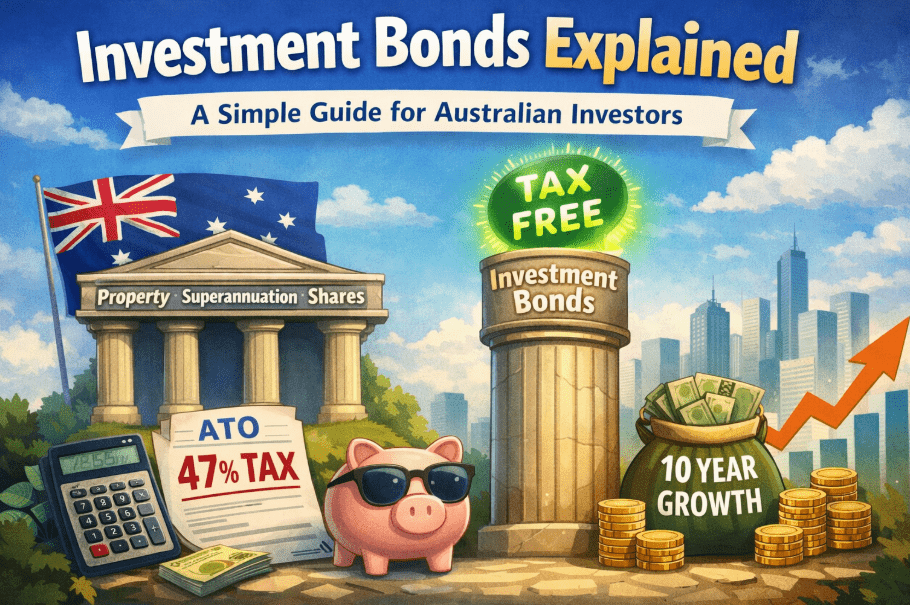
Investment Bonds Explained: A Simple Guide for Australian Investors
When it comes to building wealth in Australia, most of us are taught to look at the Big Three: property, superannuation, and shares. However, as tax brackets shift and the cost of living rises. Many savvy investors are looking for a fourth pillar to protect their wealth from the taxman.
This is where the investment bond comes into play. Often misunderstood or dismissed as old school, these financial structures are making a massive comeback. Whether you are saving for a child’s education, looking for a tax-effective alternative to super, or managing a high-income earner’s tax bill, understanding the investment bond meaning is the first step toward a more efficient portfolio.
Have a look at how these bonds work, how they compare to popular alternatives, and why they might just be the tax-paid secret your portfolio is missing.
What Exactly is an Investment Bond?
To understand the investment bond meaning, think of it as a tax-paid managed fund wrapped in a life insurance policy. Don’t let the insurance label confuse you; while they are technically life insurance contracts, they function primarily as an investment vehicle.
The investment bond structure is unique. Unlike buying shares directly, where you own the asset and pay tax on dividends at your marginal rate, an investment bond is a discretionary structure. The provider holds the assets, and you hold the policy.
The 10-Year Rule: The Holy Grail of Bond Investing
The defining feature of the investment bond structure is the “10-year rule.” If you hold the bond for at least ten years, the entire growth and the original capital can be withdrawn completely tax-free.
But there’s a catch: the 125% rule. You can add as much as you like in the first year, but in subsequent years, your contributions cannot exceed 125% of the previous year’s contribution. If you exceed this, the 10-year clock restarts.
The Tax Advantage: Why High Earners Love Them
The primary reason investors flock to this asset class is the investment bond tax treatment. Unlike shares or bank accounts, where you are taxed personally on every dollar of profit, an investment bond is tax-paid.
For a high-income professional or business owner, this creates a powerful “tax ceiling.” According to the official 2025-26 ATO Resident Tax Rates, once your taxable income exceeds $190,000, your marginal tax rate is 45%. When you add the mandatory 2% Medicare levy, you are effectively handing over 47% of your investment earnings to the government.
Here is the Immediate Win: Inside an investment bond, the provider pays a flat internal tax rate of 30%. You are essentially outsourcing your tax bill to the bond provider at a much lower rate than your own.
- If you invest in your own name, for every $1,000 your investment earns, you could pay up to $470 in tax, leaving you with only $530 to reinvest.
- If you invest via an Investment Bond, the provider pays the tax internally at 30% ($300). This leaves $700, nearly 32% more capital, to stay inside the bond and compound.
As the ATO technical guidelines confirm, you don’t even need to declare these earnings on your annual tax return while the money stays in the bond. This “invisibility” is a legal way to avoid bracket creep and keep your personal tax affairs simple.
If you are currently managing business cash flow through business lending solutions, moving your personal surplus into a bond can be a strategic way to build a private “war chest” that grows faster than a standard savings account.
Investment Bonds vs ETFs: Which is Better?
Choosing between investment bonds vs ETFs is about matching a tool to your specific tax bracket and timeline. While ETFs are the darling of the retail investing world for their low costs, high-income earners often find that the tax drag silently erodes their wealth faster than any management fee. To help you decide which vehicle fits your 2025-26 strategy, see the comparison of the two across the most critical metrics:
Investment Bonds vs. ETFs (2025-26) |
||
Feature |
Investment Bond |
Exchange Traded Fund (ETF) |
| Internal Tax Rate | Flat 30% (paid by provider) | N/A (Tax is paid by you personally) |
| Personal Tax Impact | Zero (no need to declare on your return) | 39% to 47% (added to your annual income) |
| CGT Treatment | No 50% discount (tax is internal) | 50% discount if held for >12 months |
| 10-Year Outcome | Tax-Free (including all growth) | Subject to CGT on the gain upon sale |
| Admin & Reporting | Set and forget; no annual paperwork | High; must track dividends |
| Best For | High earners (>$135k) | Low to middle-income earners |
As the table illustrates, the hidden advantage of the bond is simplicity. With an ETF, the ATO requires you to report all distributions annually, which can push you into a higher tax bracket. Conversely, the investment bond structure keeps your growth invisible to your personal tax return for the entire decade.
The “Hidden” Tax on ETFs
Many investors choose ETFs because of the ATO’s 50% CGT discount. This rule allows you to pay tax on only half of your profit if you hold the asset for over a year.
However, there is a catch. While you wait 10 years to sell and get that discount, the ETF pays you dividends every single year. For a business owner in the 47% tax bracket (45% plus 2% Medicare), nearly half of that dividend income is gone instantly. This is known as tax drag, and it significantly slows down your compounding growth.
The High-Earner Comparison (2025-26) |
||
Feature |
Direct ETF Portfolio |
Investment Bond |
| Annual Tax Bill | High (Up to 47% on all dividends) | Zero (Tax is paid internally at 30%) |
| Tax on Capital Gains | 23.5% (Your 47% rate ÷ 2) | 0% (After the 10-year mark) |
| Paperwork | Annual reporting required | None for 10 years |
| Compounding | Slowed by yearly tax payments | Faster due to lower internal tax |
Practical Example: Sarah’s “Education Nest Egg”
To see the investment bond meaning in action, let’s look at Sarah, a consultant earning $195,000 (putting her in the top 45% bracket for 2025-26). She wants to save for her daughter’s high school fees in 10 years.
- The ETF Path: Sarah invests $50,000 in her own name. Every time the ETF pays a dividend, she loses 47% of it to the ATO. When she finally sells in Year 10 to pay for school, she still owes 23.5% tax on all the growth she’s made.
- The Investment Bond Path: Sarah puts $50,000 into an investment bond. The earnings are taxed at 30% inside the bond; she never sees a tax bill. Because she follows the 10-year rule, she withdraws the entire balance in Year 10 completely tax-free.
For Sarah, the investment bond tax structure isn’t just about paying less tax; it’s about simplicity. She doesn’t have to track franking credits or capital gains for a decade, and her money grows in a protected environment.
Yields and the Economic Climate
As of early 2026, the economic landscape has shifted. According to the Reserve Bank of Australia (RBA) Interest Rate Data, the Australian 10-year government bond yield has trended significantly higher than in previous years, sitting around the 4.5% to 4.8% mark.
While these yields are lower than the stock market’s peaks, they provide a safe foundation. When paired with the 9.3% average annual return of Australian shares (per long-term Vanguard data), a balanced investment bond offers a potent mix of growth and defensive stability.
Practical Example: The Business Owner’s Second Super
Imagine a business owner who has just optimised their cash flow using equipment finance options. They have an extra $50,000 to invest, but have already maxed out their Superannuation contribution caps. An investment bond serves as a flexible pseudo-super fund:
- The Tax Cap: Like super, the bond’s internal tax is capped at 30%, a huge saving compared to the 47% top personal rate (including Medicare).
- Liquidity: Unlike Super, which is locked until age 60, you can withdraw from a bond at any time if your business needs an emergency cash injection.
- Estate Planning: You can nominate beneficiaries directly, ensuring the wealth passes to your family tax-free and without the delays of a Will.
For those already managing business lending solutions, the investment bond structure provides a high-liquidity, tax-capped “war chest” that complements a professional portfolio.
Key Benefits at a Glance
- No Annual Tax Reporting: You don’t need to include bond earnings in your tax return unless you withdraw within the first 10 years.
- Estate Planning: You can nominate beneficiaries, meaning the bond passes directly to them upon your death, bypassing the delays of probate and the complexity of Wills.
- Bankruptcy Protection: In many cases, investment bond assets are protected from creditors, making them popular for business owners and directors.
- Flexibility: While the 10-year rule is the goal, you can access your money earlier if needed (though some tax will apply to the growth).
The Downside: What to Watch Out For
No investment is perfect. When weighing up investment bonds vs ETFs, you must consider:
- Higher Fees: Bond providers charge for the administration and tax management, which is usually higher than a cheap index ETF.
- The 30% Tax is Fixed: If you are a low-income earner (earning less than $45,000), you are actually paying more tax inside a bond than you would outside of it.
- No CGT Discount: The bond provider pays the tax, so you lose the 50% CGT discount you would normally get for holding an asset for more than 12 months personally.
Is an Investment Bond Right for You?
At Efficient Capital, we believe true wealth isn’t just about what you earn, it’s about what you keep. Whether you are scaling your business through business lending or protecting your personal gains, a strategic approach is vital.
Ready to see if a bond fits your 2026 strategy? Start by identifying one long-term goal, like a child’s education or a 10-year retirement gap, and compare the after-tax outcome of a bond versus your current savings method.