

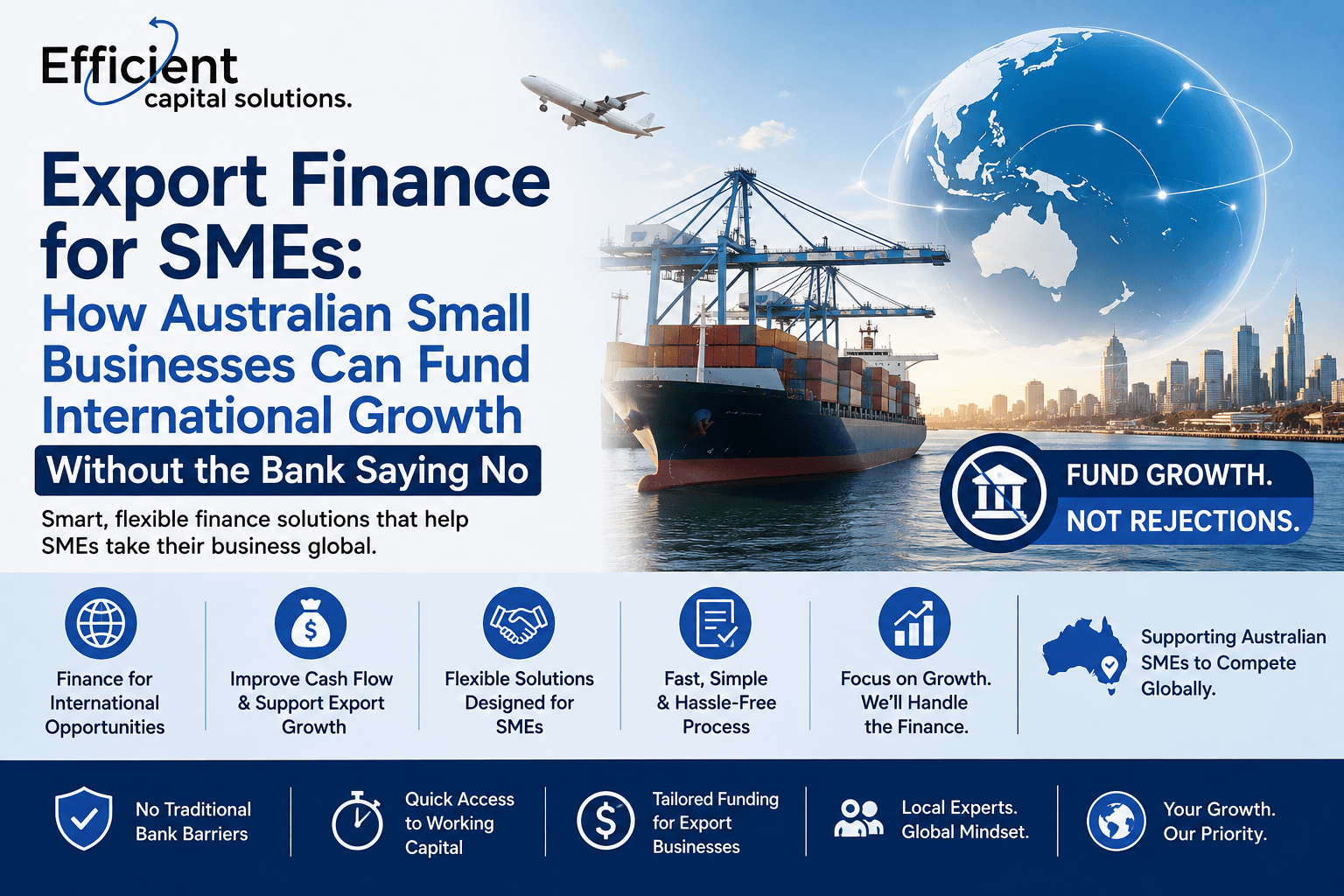
Property Development Loan Sydney: Your First Site and Why the Bank’s ‘No’ Isn’t Final
You Won the Contract. Now What?
Picture this: after months of pitch decks, Zoom calls, and relentless follow-up, you’ve just landed a purchase order from a buyer in Singapore, the UAE, or the United States. It’s the biggest deal your business has ever seen. The only problem? They pay in 60 to 90 days — and your supplier wants cash upfront before they ship a single unit.
This is the defining pain point that makes export finance for SMEs one of the fastest-growing financing categories in Australia right now. You have the demand. You have the capability. What you don’t have is the working capital to bridge the gap between production and payment.
This guide breaks down exactly how export finance for SMEs works, why Australian banks are increasingly leaving smaller exporters out in the cold, and what non-bank alternatives now exist to help you fund international growth without stalling the deal of your life.
What Is Export Finance for SMEs?
Export finance for SMEs is a category of short-term business funding designed specifically to cover the cash flow gap that arises when a small or medium-sized enterprise wins an overseas contract but must produce, package, and ship goods — or deliver a service — before the buyer pays.
Unlike a standard business loan, export finance for SMEs is tied directly to the export transaction itself. The contract or purchase order often serves as the underlying security, which means you don’t necessarily need bricks-and-mortar collateral to access it.
Common forms of export finance for SMEs include:
- Export working capital loans — short-term loans drawn against confirmed purchase orders to cover pre-shipment costs like raw materials, labour, and packaging.
- Invoice finance on export receivables — once you’ve shipped, you unlock the invoice value immediately rather than waiting 60–120 days for the foreign buyer to pay.
- Trade finance / letter of credit facilities — a structured facility where a lender guarantees payment to your supplier on your behalf, removing the supplier’s payment risk and letting production begin.
- Export credit finance Australia (government-backed) — facilities historically offered through EFIC (Export Finance Australia), now increasingly supplemented by non-bank and private credit providers.
Each of these products is a distinct tool within the export finance for SMEs toolkit. The right one depends on your transaction structure, buyer terms, and the stage of your cash flow cycle.
Why Australian Banks Are Pulling Back From Small Business Export Deals
Here’s the uncomfortable truth driving the surge in export finance for SMEs from alternative lenders: the major Australian banks have largely retreated from smaller cross-border deals.
The reason is risk assessment, not risk itself. For a Big Four bank to underwrite an export facility for an SME shipping into Southeast Asia or the Middle East, their credit teams need to understand the buyer’s creditworthiness in a foreign jurisdiction, the currency exposure, and the legal enforceability of the contract — all for a deal that may only be worth $150,000 to $500,000. The compliance overhead isn’t worth it at that ticket size.
This means thousands of Australian SMEs with legitimate, signed purchase orders from creditworthy international buyers are being told “no” — or more often, simply ignored — by the institutions they’ve banked with for years.
The gap has been enormous. And it’s exactly where specialist non-bank providers of export finance for SMEs have stepped in aggressively.
According to industry data, non-bank trade and export finance in Australia has grown significantly as traditional banks have reduced their appetite for sub-$2 million international transactions. For SME owners, this shift is actually good news: specialist lenders price and structure export finance for SMEs based on the quality of the transaction, not just the balance sheet of the borrowing entity.
The Hidden Cost of Not Accessing Export Finance for SMEs
Many small business owners assume that if the bank says no, the deal simply can’t be done. That’s a $200,000 mistake.
When an SME can’t access export finance for SMEs and the deal falls through, the real cost isn’t just the lost profit margin on that particular contract. It’s the buyer relationship that may not come back. It’s the referral that doesn’t happen. It’s the reputational signal to international markets that your business can’t execute at scale.
On the other side, businesses that can access export finance for SMEs — and consistently deliver on international contracts — build track records that compound. Each completed deal improves your standing with financiers, your relationship with buyers, and your own operational capability.
The cost of inaction on export finance for SMEs is always higher than the cost of the facility.
How Export Working Capital Loans Actually Work
An export working capital loan is the most direct form of export finance for SMEs. Here’s a simplified walkthrough:
- You receive a confirmed purchase order from an overseas buyer — ideally from a buyer with verifiable creditworthiness.
- You apply for an export working capital loan with a non-bank lender or trade finance specialist. The lender assesses the buyer, the contract terms, and your business’s fulfilment history.
- Funds are advanced — typically 70–90% of the purchase order value — to cover pre-shipment costs: raw materials, manufacturing, freight booking, and packaging.
- You produce and ship the goods or deliver the service.
- The buyer pays into a designated account. The lender is repaid first, and the remaining margin is released to you.
The whole cycle might run 30 to 90 days, making export finance for SMEs via working capital loans one of the more flexible short-term financing instruments available to growing businesses.
Interest and fees vary based on the lender, the transaction risk, and the buyer’s creditworthiness — but because non-bank lenders in the export finance for SMEs space price based on transaction quality rather than pure credit score, even businesses with imperfect financials can access funding if the underlying deal is strong.
Export Credit Finance Australia: EFIC and Its Limitations for SMEs
Export Finance Australia (formerly EFIC) is the Australian government’s export credit agency, and it plays an important role in the broader export finance for SMEs ecosystem — particularly for larger or more complex transactions, emerging market buyers, or deals with significant political risk.
However, EFIC has limitations that make it inaccessible or impractical for many SMEs:
- Minimum transaction sizes that leave smaller deals unqualified
- Lengthy assessment processes that don’t match the fast turnaround often required in international trade
- Eligibility criteria that favour exporters with established track records and stronger balance sheets
This is not a criticism of Export Finance Australia — the agency is designed to fill a specific gap in the market. But for a $250,000 purchase order that needs to be funded within two weeks, EFIC is rarely the answer.
The practical implication for most businesses seeking export finance for SMEs is that they need to look at specialist non-bank lenders who can move faster, underwrite the transaction directly, and structure export finance for SMEs facilities with the agility that export timelines demand.
What Makes a Strong Application for Export Finance for SMEs?
Understanding what lenders assess when evaluating export finance for SMEs applications helps you prepare stronger submissions and access better rates.
- The buyer’s creditworthiness
In most export finance for SMEs facilities, the buyer’s ability and willingness to pay is as important — sometimes more important — than the borrower’s own balance sheet. Lenders want to see a named, verifiable buyer with a track record of paying international suppliers on time. - The quality of the purchase order or contract
A signed, detailed purchase order that specifies goods, quantities, pricing, payment terms, and delivery obligations is the backbone of any export finance for SMEs application. Vague or informal agreements create friction. - Your track record in fulfilling export orders
First-time exporters can still access export finance for SMEs, but if you have a history of on-time delivery, documented shipping records, and completed trade references, your application will be assessed far more favourably. - Your business’s financial health
While export finance for SMEs lenders focus heavily on the transaction, they still want to see that your business is fundamentally solvent. Clean BAS lodgements, no ATO debt, and reasonable trading history all help. - The product or service being exported
Lenders have varying appetites for different export categories. Food and agribusiness, manufactured goods, technology services, and professional consulting all carry different risk profiles in the context of export finance for SMEs.
Small Business Export Funding: Real Scenarios Where It Makes a Difference
Scenario 1: The food manufacturer
A Brisbane-based specialty food producer receives a $320,000 purchase order from a retail chain in Japan. Delivery is required within eight weeks, and the buyer pays net-60. The manufacturer needs to purchase raw ingredients and run two production shifts immediately. An export finance for SMEs working capital loan covers the inputs upfront. The deal gets done, and the manufacturer builds a recurring relationship with the Japanese buyer.
Scenario 2: The IT services firm
A Sydney software consultancy wins a project with a New Zealand government department worth $180,000. The contract requires four senior developers to be billable from day one, but payment comes 45 days after monthly invoicing. Invoice finance on export receivables — a form of export finance for SMEs — lets the business draw down on invoices as they’re issued, keeping payroll funded throughout the engagement.
Scenario 3: The industrial equipment supplier
A Melbourne business supplying mining equipment to a buyer in Indonesia needs its supplier in Germany to manufacture a custom component before it can ship. The overseas supplier won’t begin without payment. A trade finance facility — a structured form of export finance for SMEs — issues a letter of credit to the German supplier, triggering production and giving the buyer in Indonesia confidence that delivery will occur. The Australian SME executes a deal it would otherwise have had to decline.
These are not edge cases. They are the everyday reality of Australian businesses trying to grow internationally without sufficient working capital — and the reason demand for export finance for SMEs is accelerating.
The Non-Bank Advantage: Why EFIC Alternative Lenders Are Growing Fast
The term “EFIC alternative lenders” describes a growing market of private credit providers, specialist trade finance firms, and finance brokers that structure export finance for SMEs outside the traditional banking and government credit agency system.
What makes these providers genuinely different in the export finance for SMEs space?
Speed. Non-bank lenders can often issue term sheets for export finance for SMEs facilities within 48 to 72 hours, compared to weeks or months with a major bank.
Transaction-based underwriting. Rather than running your P&L through a lending scorecard built for domestic business loans, non-bank export finance for SMEs providers look at the deal itself — the buyer, the contract, the shipping logistics — and lend against that.
Flexibility. Export transactions don’t fit neatly into standard loan products. Non-bank providers of export finance for SMEs can structure hybrid facilities that combine pre-shipment funding, post-shipment invoice finance, and foreign currency management in a single package.
Relationship access. A specialist finance broker with connections across the export finance for SMEs market can simultaneously approach multiple non-bank lenders and present the strongest possible deal on your behalf — something a business owner rarely has the bandwidth to do alone.
Choosing a Finance Broker for Export Finance for SMEs
If you’re accessing export finance for SMEs for the first time — or if a bank has already declined your application — working with a specialist finance broker is almost always the right move.
Here’s what a good broker does in the export finance for SMEs context:
- Assesses your transaction and identifies which lenders or facilities are the best match
- Packages your application in a way that presents the buyer and deal quality clearly
- Negotiates pricing and structure across multiple non-bank lenders simultaneously
- Manages the process from application through to drawdown, keeping your deal timeline intact
- Provides ongoing access as your export volumes grow and your financing needs evolve
The cost of using a broker for export finance for SMEs is typically recovered many times over in better pricing, faster execution, and the ability to do deals that would otherwise fall apart.
What Does Export Finance for SMEs Cost?
Pricing for export finance for SMEs depends on a range of factors, including transaction size, buyer creditworthiness, duration, and the specific facility type. As general guidance:
- Export working capital loans typically carry interest rates in the range of 8–18% per annum, often quoted on a monthly or per-deal basis rather than an annual rate.
- Invoice finance on export receivables may carry a discount rate of 1–3% per month on the face value of invoices, depending on the buyer’s credit profile and the currency.
- Trade finance / letter of credit facilities carry fees structured around the face value of the LC, typically 1–2.5% per 90-day period plus arrangement fees.
These costs should always be assessed against the margin on the export deal itself. For a transaction with a 25% margin, an export finance for SMEs cost of 3–5% of deal value is a worthwhile trade-off to execute the contract and preserve the buyer relationship.
Many businesses accessing export finance for SMEs for the first time are surprised to find that the facility cost is far outweighed by the value of the deal being funded.
Common Mistakes SMEs Make When Seeking Export Finance
Even with a strong deal in hand, there are avoidable errors that slow down or derail access to export finance for SMEs:
Leaving it too late. Export timelines are tight. The worst time to start your export finance for SMEs search is the week before your supplier needs payment. Build the facility before you need it, not during the crisis.
Approaching only one lender. The export finance for SMEs market is fragmented. Different lenders have different appetites for different buyer countries, product categories, and deal sizes. A single rejection tells you nothing about the market.
Presenting weak documentation. Lenders in the export finance for SMEs space are making fast decisions. Clear, complete documentation — signed contracts, buyer details, logistics plans, and financial statements — accelerates the process dramatically.
Confusing domestic and export facilities. A standard business overdraft or trade finance facility structured for domestic transactions is not the same thing as export finance for SMEs. Make sure you’re applying for the right product.
Not using a broker. The export finance for SMEs market is not something most business owners navigate more than a handful of times. A broker who lives in this space every day has structural advantages in terms of lender relationships, deal structuring, and speed.
FAQ: Export Finance for SMEs
Q: Can I access export finance for SMEs if my business has only been operating for two years?
Yes, in many cases. Non-bank lenders offering export finance for SMEs focus heavily on the transaction and the buyer. A newer business with a strong purchase order from a creditworthy international buyer is often approvable, even without a long trading history.
Q: Does export finance for SMEs cover service-based exports?
Increasingly, yes. Providers of export finance for SMEs have expanded their criteria to cover professional services, technology, consulting, and creative services exports — not just physical goods.
Q: What currencies can export finance for SMEs be structured in?
Many non-bank lenders structure export finance for SMEs in the transaction currency — USD, EUR, GBP, SGD, and others — to reduce foreign exchange risk for the borrower.
Q: How quickly can I access an export finance for SMEs facility?
With a specialist broker and complete documentation, some export finance for SMEs facilities can be structured and funded within five to ten business days. More complex deals may take two to four weeks.
Q: Is export finance for SMEs available for buyers in high-risk jurisdictions?
It depends on the jurisdiction and the specific lender. Some export finance for SMEs providers have appetite for emerging market buyers, particularly where the buyer is a large, established entity or where trade credit insurance is available.
The Bottom Line: Export Finance for SMEs Is a Growth Lever, Not Just a Gap-Fill
The businesses that grow fastest in international markets aren’t always the ones with the most capital. They’re the ones that understand how to leverage export finance for SMEs to turn confirmed demand into executed revenue, consistently and at pace.
Every international purchase order you decline because you can’t fund production is lost revenue that your competitor — one who understands export finance for SMEs — will capture instead.
Export finance for SMEs is not a sign of financial weakness. It is a strategic tool used by the world’s most successful exporters, scaled for the Australian SME market and increasingly accessible through non-bank lenders who understand what it takes to execute cross-border deals.
The market for export finance for SMEs in Australia has never been more developed. The lender appetite has never been broader. And the need — driven by a generation of Australian businesses with international ambition and international buyers who want what they offer — has never been greater.
Ready to Fund Your Next Export Deal?
At Efficient Capital Solutions, we work with Australian SMEs across manufacturing, technology, agriculture, professional services, and more to structure export finance for SMEs facilities that move as fast as your deals require.
Our team understands the non-bank landscape for export finance for SMEs in depth — including which lenders have genuine appetite for your buyer country, your product category, and your deal size. We don’t just submit applications; we build the case for your transaction and advocate for your business across the market simultaneously.
Whether you’re looking at your first export working capital loan, seeking export credit finance Australia alternatives after a bank decline, or wanting to build a standing small business export funding facility for ongoing international growth — we can help you find the right structure, at the right cost, in the time your deal demands.
Talk to the Efficient Capital Solutions team today — and let’s make your next international contract the one that actually gets funded.
Or explore our Working Capital Finance services to see the full range of export and trade finance options we work with.
Efficient Capital Solutions is a full-service finance brokerage based in Sydney, Australia. We help SMEs, property investors, and individuals access the right lending solutions across commercial finance, working capital, trade finance, and export funding. Our team of experienced brokers works across a broad panel of bank and non-bank lenders to find the best fit for your situation.