

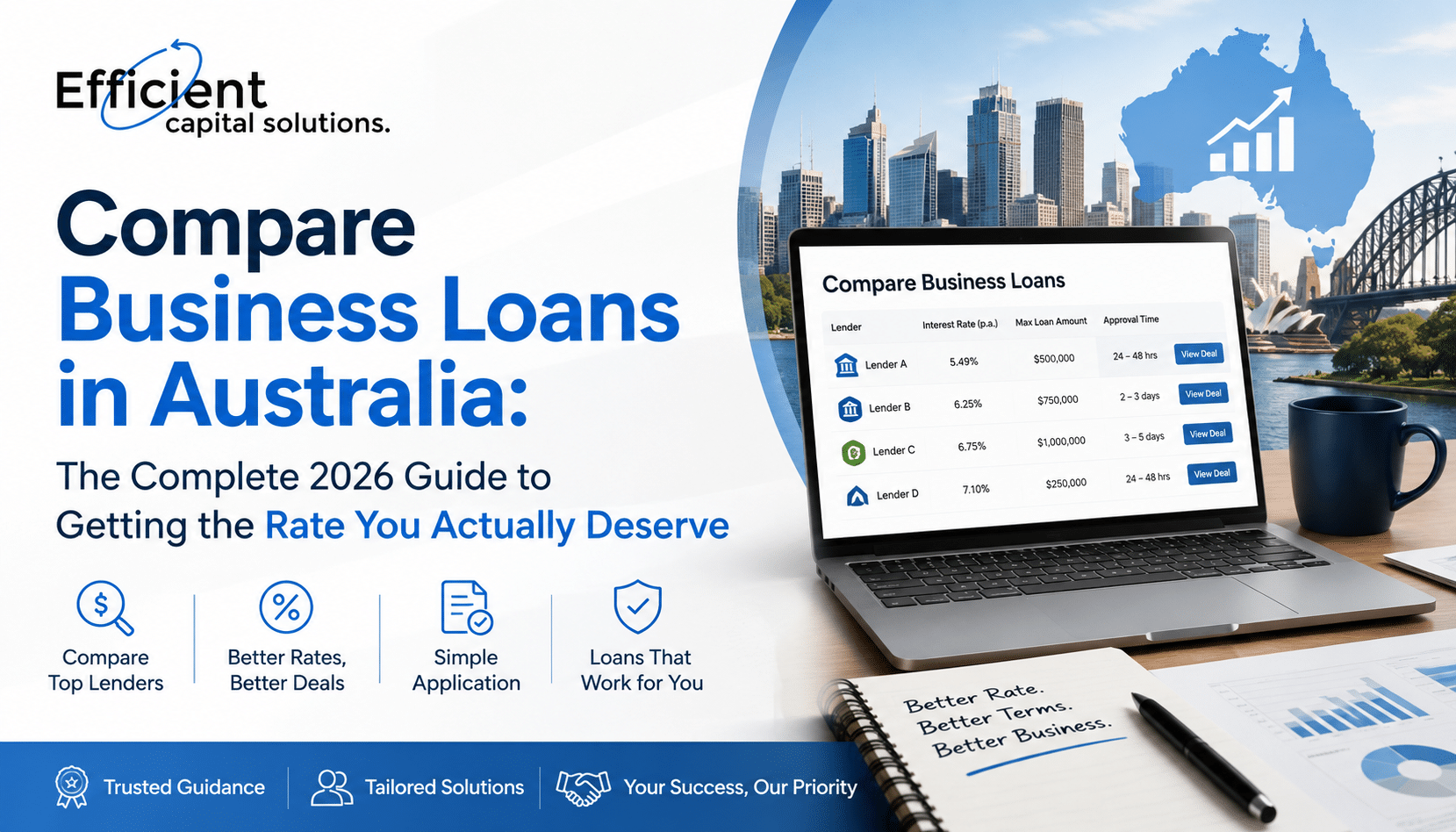
Compare Business Loans in Australia: The Complete 2026 Guide to Getting the Rate You Actually Deserve
Compare Business Loans in Australia: The Complete 2026 Guide to Getting the Rate You Actually Deserve
To compare business loans in Australia, look beyond the advertised rate. Factor in comparison rates, establishment fees, ongoing charges, security requirements, and lender risk pricing. Business loan interest rates in Australia currently range from roughly 7% to 25%+ p.a. depending on loan type, lender, and your business profile. The best way to compare business loan rates is to work with an accredited commercial finance broker who can access multiple lenders simultaneously and negotiate on your behalf.
Why Comparing Business Loans Has Never Been More Important
If you’ve been trying to compare business loans recently, you already know the frustration. You land on a comparison website, see a headline rate that looks reasonable, and then — somewhere between the application form and the final offer — the number shifts. Suddenly there are fees you didn’t anticipate, a rate loading for your industry, or a security requirement that changes the entire deal.
You’re not imagining it. This gap between what’s advertised and what’s actually offered is one of the defining pain points for Australian SMEs in the current lending environment. Small-business borrowing costs remain materially above rates available to large corporates, and with lenders still actively repricing in a prolonged high-rate environment, the difference between a good deal and a costly one has never been wider.
That’s why learning to genuinely compare business loan interest rates — not just the marketing number — is one of the most valuable financial skills a business owner can develop right now.
This guide walks you through everything: what types of business loans exist, what drives the rate you’re actually offered, the hidden costs that erode real value, and how to run a meaningful comparison before you sign anything.
The Landscape: What Types of Business Loans Can You Actually Compare?
Before you compare business loan rates, it helps to know what you’re comparing. Not all business finance products are structured the same way, and mixing product types in a comparison is a common mistake.
Unsecured Business Loans
These loans don’t require property or assets as collateral. Because the lender carries more risk, rates are typically higher — often between 12% and 25%+ p.a. for short-term unsecured facilities. They suit businesses that need fast access to capital, don’t own property, or want to avoid using personal assets as security.
Secured Business Loans
When you pledge real property — commercial or residential — as security, lenders price the loan significantly lower, often in the 7% to 12% range for well-qualified borrowers. Approval timelines are longer and documentation requirements more substantial, but the cost difference over a three-to-five-year term can be substantial.
Business Lines of Credit / Overdrafts
These revolving facilities let you draw and repay as needed, paying interest only on what you use. They’re excellent for managing working capital gaps but are often misused for long-term asset purchases, where a term loan would be more appropriate and cheaper.
Equipment Finance and Chattel Mortgage
The financed asset itself serves as security, so rates are competitive — typically in the 8% to 14% range — and approval is often faster than for property-secured loans. These are purpose-built products for plant, vehicles, and machinery.
Invoice Finance
Rather than a loan in the traditional sense, invoice finance unlocks cash tied up in outstanding receivables. You receive a percentage of invoice value upfront, with the remainder (minus fees) paid when your customer pays. The effective cost can be surprisingly competitive for cash-flow-positive businesses with strong debtors.
Low-Doc Business Loans
Designed for self-employed borrowers or businesses that can’t easily produce full financials, low-doc products carry a rate premium but offer genuine access to capital. If you’re comparing business loans as a sole trader or newer business, these may be the most relevant products to evaluate.
Understanding which product fits your purpose is step one. Step two is understanding why the rate you’re quoted may differ substantially from what you see advertised.
What Actually Determines Your Business Loan Interest Rate?
This is where most business owners get caught out. The rate you’re offered isn’t a fixed number — it’s the output of a risk-pricing model that weighs multiple factors specific to your business. Here’s what lenders actually look at:
1. Business Age and Track Record
Most mainstream lenders want to see at least two years of trading history. Businesses under two years old are priced as higher risk, even if revenue is strong. Some lenders won’t approve newer businesses at all, pushing them toward specialist or non-bank lenders with higher rate floors.
2. Annual Turnover
There’s a significant difference in how lenders price a $500,000-turnover business versus a $2 million business. Higher turnover generally signals capacity to service debt, reducing perceived risk. Some lenders set hard minimum turnover thresholds — often $100,000 to $250,000 p.a.
3. Security Offered
As noted above, offering real property security can reduce your effective rate by 5–10 percentage points in some cases. But security type matters too: residential property is viewed more favourably than commercial, and first-mortgage positions command better pricing than second-mortgage security.
4. Industry Risk Classification
Lenders maintain internal risk classifications for industries. Hospitality, construction, and retail typically attract higher risk loadings than professional services, healthcare, or property-adjacent businesses. If your sector has had high default rates historically, that cost is passed to new borrowers.
5. Credit Profile — Business and Personal
Most SME lenders assess both the business credit file and the directors’ personal credit history. A single credit default or court judgment can exclude you from prime lenders entirely, or add several percentage points to your rate.
6. Cash Flow and Serviceability
Lenders calculate whether your business generates enough net cash flow to comfortably service the proposed debt. They’ll often apply a buffer above the actual rate (called a stress rate or floor rate) to ensure you’d still meet repayments if rates rose. If your margins are tight, even a profitable business can be declined on serviceability grounds.
7. Loan-to-Value Ratio (LVR)
For secured loans, the ratio of your loan amount to the value of the security property directly affects your rate. An LVR below 60–65% typically attracts the sharpest pricing; above 80% and some lenders will decline outright.
The critical takeaway: two businesses applying for the same product on the same day can receive wildly different rates. A comparison website showing a single headline figure doesn’t capture this reality.
Decoding the True Cost: Beyond the Interest Rate
When you compare business loans interest rates, the advertised rate is just the starting point. Here are the costs that can materially change what a loan actually costs you:
Establishment / Application Fees
These are one-off fees charged when the loan is set up. They can range from $0 with some fintech lenders to $3,000–$5,000 or more with traditional lenders on larger facilities. On a $200,000 loan, a $4,000 establishment fee adds 2% to your effective borrowing cost upfront.
Ongoing Monthly / Annual Fees
Many business loan products carry an ongoing administration or facility fee — sometimes $20–$50 per month on smaller facilities, more on larger ones. Over a five-year term, these fees can add thousands to your total cost.
Early Repayment Charges
If you anticipate paying down your loan early — because of a business sale, refinance, or strong cash flow — break costs or early repayment fees can be painful. Some lenders charge several months’ interest as a penalty. Always check the exit provisions before signing.
Brokerage or Origination Fees
If using a broker, understand how they’re compensated. A good commercial broker is paid by the lender (upfront and trail commission) in most cases, meaning the service is free to you. However, some brokers charge additional fees — something worth clarifying upfront.
Legal and Valuation Fees
For secured loans, you’ll typically need to pay for a property valuation and potentially legal fees for loan documentation. Budget $500–$2,000+ depending on the complexity of the security arrangement.
The Comparison Rate Concept
For personal loans and some consumer products, lenders are required to display a comparison rate that incorporates fees. For business loans, this requirement doesn’t apply in the same way — which is part of why it’s so hard to compare business loans on an apples-to-apples basis without professional help.
How to Actually Compare Business Loans in Australia: A Step-by-Step Framework
Armed with an understanding of what drives rates and what adds cost, here’s a practical framework for running a genuine comparison.
Step 1: Define Your Loan Purpose and Term
The purpose of your loan matters enormously. Equipment finance and a working capital facility are different products even if the amounts are similar. Clarity on purpose helps identify which products are actually comparable.
Step 2: Establish Your Business Profile
Before approaching lenders, compile your key metrics: years in business, annual turnover, net profit, assets available as security, and personal credit position. This lets you self-qualify before investing time in applications.
Step 3: Request Total Cost of Credit Figures
Don’t ask for a rate. Ask lenders or brokers to provide the total amount repayable over the loan term, including all fees. This is the most honest basis for comparison.
Step 4: Compare Like for Like
A 12-month unsecured facility from a fintech is not comparable to a 5-year secured term loan from a bank. When you compare business loans rates, ensure the term, product type, and security structure are consistent across quotes.
Step 5: Understand the Conditions Attached
Some low-rate offers come with restrictive covenants: minimum turnover requirements, mandatory account holding with the lender, restrictions on taking additional debt, or personal guarantee requirements that weren’t prominently disclosed. Read the credit schedule and facility agreement, not just the approval letter.
Step 6: Factor in Lender Access and Turnaround
Rate isn’t everything. If you need funds in 48 hours, a bank offering a slightly lower rate but requiring six weeks to settle isn’t practically useful. Turnaround time is a legitimate part of the comparison when urgency is a factor.
Step 7: Use a Broker to Access the Wider Market
Independently approaching major banks gives you access to perhaps four or five lenders. A quality commercial finance broker has access to dozens of lenders — major banks, regional banks, non-bank lenders, private credit providers — and can run a genuine market comparison on your behalf in a fraction of the time.
Bank vs. Non-Bank Lenders: Where Should You Compare?
Australian business borrowers have access to a broader range of lenders than many realise. Here’s a simplified landscape:
Major Banks (Big Four + Macquarie): Typically the sharpest rates for well-qualified borrowers with strong financials, trading history, and security. Approval processes are thorough and timelines can be slow. Best suited to established businesses with clean credit and full documentation.
Regional and Mutual Banks: Often more flexible on policy and faster to respond than the majors. Worth including in a comparison, particularly for borrowers in specific industries where the regional bank has specialist appetite.
Non-Bank Lenders (e.g., Liberty, Pepper, La Trobe, Shift, Judo): These lenders have grown significantly in the SME space. They can often accommodate scenarios the majors won’t — newer businesses, complex structures, non-standard security — with faster approvals. Rates are typically higher but access to capital is better.
Fintech Lenders (e.g., Prospa, Moula, Lumi): Designed for speed and simplicity. Applications are often decided algorithmically using bank statement data and accounting software integrations. Rates are highest in this category but approvals can be same-day. Suitable for small, short-term funding needs.
Private Lenders: For complex, time-sensitive, or non-conforming scenarios, private credit providers offer solutions outside the standard credit matrix. Rates are premium but can be the only option when conventional lenders aren’t viable.
Understanding where you sit on this spectrum — and which lenders are likely to compete for your business — is where an experienced broker adds enormous value.
Common Mistakes When Comparing Business Loans
Even well-informed business owners make these errors:
Comparing rates across different product types. A secured rate versus an unsecured rate isn’t a valid comparison — the risk structure is entirely different.
Applying to multiple lenders simultaneously. Multiple credit enquiries in a short window can damage your credit score and signal financial distress to lenders. Use a broker who can approach lenders pre-conditionally before formal applications are lodged.
Focusing only on the interest rate. A loan at 9.5% with $5,000 in fees and a 12-month lock-in may be more expensive than one at 10.2% with no fees and full flexibility.
Not reading the personal guarantee terms. Most SME lenders require directors to provide a personal guarantee. Understand exactly what you’re guaranteeing — the loan amount, costs, default interest — before signing.
Borrowing without a repayment strategy. A business loan is a tool. Without a clear plan for how the borrowed capital will generate returns that exceed the cost of debt, even the cheapest loan is a poor decision.
Underestimating the value of a relationship. If you plan to grow and borrow again, establishing a track record with a lender can open better terms on future facilities. Purely rate-optimising every transaction can undermine your long-term banking relationships.
FAQs: Compare Business Loans Australia
What is the average business loan interest rate in Australia in 2026?
Business loan interest rates in Australia vary widely depending on the product, lender, and borrower profile. Secured business loans from major banks can start from around 7–8% p.a. for well-qualified borrowers, while unsecured fintech products can exceed 20–25% p.a. for short-term facilities. Speaking with a broker gives you the most accurate rate estimate for your specific scenario.
Can I compare business loans without affecting my credit score?
Yes — compare business loans a knowledgeable broker can approach lenders on a pre-conditional or indicative basis before formal applications are lodged, minimising hard credit enquiries. Applying directly to multiple lenders simultaneously is risky and can negatively affect your credit file.
How long does it take to compare and settle a business loan in Australia?
Fintech lenders can approve and fund within 24–48 hours. Non-bank lenders typically take 3–10 business days. Major banks can take 4–8 weeks for complex or property-secured facilities. If time is a factor, discuss this upfront when comparing options.
Do I need a business plan to compare business loans rates?
Not always. For smaller unsecured loans, lenders often make decisions based on bank statements and accounting data alone. For larger secured facilities, a business plan, financial projections, and detailed trading statements are usually required.
What’s the difference between a business loan rate and a comparison rate?
For business loans in Australia, there’s no mandatory comparison rate disclosure as there is for consumer products. The “comparison rate” concept for business loans requires manually calculating total cost of credit including all fees — which is why working with a broker who can model this across multiple lenders is so valuable.
Is a broker free to use for business loans?
In most cases, yes. Commercial finance brokers are typically paid by the lender (via upfront and trail commission) at no direct cost to the borrower. Some complex transactions may involve a broker fee — always ask for a disclosure of how your broker is remunerated.
What security do I need to compare business loans rates securly?
Residential or commercial property is most commonly accepted. The stronger the security — higher value, clear title, low LVR — the more competitive the rates available to you. Some lenders also accept business assets, debtors, or director guarantees without requiring property.
The Efficient Capital Solutions Advantage: Compare Business Loans Rates Across Australia’s Widest Lending Panel
At this point, you understand the complexity involved in comparing business loans properly. It’s not a five-minute exercise on a comparison website — it’s a nuanced process that requires knowledge of lender appetite, product structures, credit policy, and negotiation.
That’s precisely where Efficient Capital Solutions comes in.
Based in Sydney and working with SMEs across Australia, Efficient Capital Solutions is a specialist commercial finance broker with access to one of Australia’s broadest lending panels — including major banks, regional lenders, non-bank credit providers, and private funders. Rather than going to one or two lenders and hoping for a decent rate, Efficient Capital Solutions runs a comprehensive market comparison on your behalf, identifies the lenders most likely to compete for your business, and negotiates hard on your terms.
What makes Efficient Capital Solutions different:
- Whole-of-market access: One conversation unlocks dozens of lenders, not just whoever has the best advertising budget.
- True total-cost analysis: Efficient Capital Solutions compare business loans the full cost of credit — rate, fees, conditions, flexibility — not just the headline number.
- Specialist commercial expertise: Business lending is fundamentally different to home loans. Their team understands industry risk classifications, serviceability calculations, and structuring options that generic brokers often miss.
- Speed when you need it: Whether you need funds next week or you’re planning a strategic acquisition six months out, Efficient Capital Solutions tailors the process to your timeline.
- No upfront cost: Like all accredited commercial brokers, Efficient Capital Solutions is remunerated by lenders, meaning their comparison service comes at no direct cost to your business.
Ready to Compare Business Loans with Confidence?
Stop guessing at advertised rates and start getting real offers based on your actual business profile.
Book a free consultation with Efficient Capital Solutions →
Or explore their full range of commercial finance solutions — from business loans and equipment finance to working capital and SMSF lending — at efficientcapital.com.au.
Related Services from Efficient Capital Solutions
- Business Loans Australia — Tailored term loans for growth, acquisition, and working capital.
- Commercial Finance — Equipment finance, SMSF lending, vehicle loans, and more.
- Working Capital Finance — Invoice finance, trade finance, overdrafts, and bridging solutions.
- Financial Advisory — Debt structuring, investment analysis, and business forecasting.
This article is for general information purposes only and does not constitute financial advice. Business lending terms, interest rates, and lender policies are subject to change. Consult with an accredited finance professional before making borrowing decisions.