

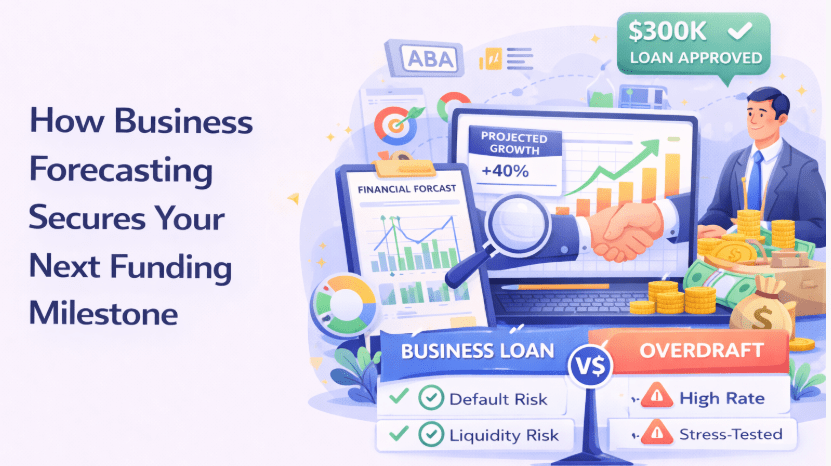
How Business Forecasting Secures Your Next Funding Milestone
In the Australian business landscape, hope is a wonderful motivator, but it is a terrible strategy. Whether you are a boutique firm in Melbourne or a scaling enterprise in Perth, the distance between “having a great idea” and “securing the capital to fund it” is bridged by one critical discipline: Business Forecasting.
When you approach a lender or an investor, you aren’t just asking for money; you are asking them to buy into a version of the future. But in a post-pandemic economy marked by fluctuating interest rates and shifting consumer demands, “gut feeling” no longer passes the stress test. To meet modern loan requirements, you need to prove that you can see around corners.
The New Reality of the Australian Lending Market
The appetite for lending in Australia has undergone a massive shift. According to the ABA SME Lending Report 2021, during the height of the pandemic, over 225,000 SME loans worth more than $50 billion were deferred. This period taught lenders a harsh lesson in volatility. Interestingly, while 40% of SMEs aimed for revenue growth at that time, only 4% planned to take on more debt. This disconnect highlights a “caution gap” that only high-quality financial forecasting can close.
Lenders today aren’t just looking at your past performance; they are looking at your “forward-looking capability.” They want to know that if they provide business funding, you have a roadmap to navigate the peaks and troughs of the Australian market.
1. Turning Data into Narrative: The Power of Financial Forecasting
At its core, financial forecasting is the process of estimating a company’s future financial outcomes by examining historical data, market trends, and upcoming internal changes. For a lender, this isn’t just a spreadsheet; it’s a story of your competence.
When you present a forecast, you are demonstrating that you understand your “Unit Economics”, exactly how much it costs to acquire a customer and how much profit that customer generates over time. In a climate where the average small business loan size increased by 15% (from $2.9M to $3.4M), the stakes for accuracy are higher than ever.
A robust forecast addresses the two biggest fears of any credit committee:
- Default Risk: Can you pay the interest even if sales dip?
- Liquidity Risk: Will you run out of cash while waiting for invoices to be paid?
By using Efficient Capital’s business loans framework, you can align your forecasts with the specific criteria lenders use to assess these risks, ensuring your application doesn’t just sit in a pile but moves toward funding approval.
2. Proving “Serviceability” in a High-Interest Environment
In Australia, the term “serviceability” is king. APRA’s macroprudential settings, which include a 3% mortgage serviceability buffer, have a trickle-down effect on how business risk is perceived. If you cannot forecast your ability to service a loan under “stressed” scenarios (e.g., interest rates rising or a key supplier increasing costs), your chances of funding approval plummet.
Business Forecasting allows you to perform “What-If” analysis. What if the AUD drops? What if your freight costs double? When you show a lender that your business remains viable even in these scenarios, you aren’t just showing a budget; you’re showing a risk-mitigation strategy. This level of detail is often a mandatory part of modern loan requirements.
3. State of the Nation: Optimism vs. Reality
Data from the SME Growth Index (22nd Ed.) shows a fascinating divide in the Australian market. While 60% of SMEs forecast revenue growth through to late 2025, some sectors are projecting contractions of up to 30%.
Geographic trends also play a role. Insights also indicate that 91% of SMEs in Western Australia are optimistic about revenue rises, compared to more tempered views in Victoria.
Why does this matter for your business funding? Because lenders look at benchmark data. If you are a Victorian business forecasting 50% growth while the rest of your sector is flagging, you need the data to back it up. Business Forecasting allows you to justify your optimism with logic, making your case for a loan much more authoritative.
4. Accuracy Breeds Credibility
There is a common misconception that a forecast has to be 100% “right” to be valuable. In reality, forecasting is about reducing the margin of error. Even the Australian Treasury Forecasting Review notes that budget revenue forecasts carry an average absolute error of about $8 billion.
The lesson for SMEs? Lenders value the process of financial forecasting as much as the numbers themselves. It shows you have your hand on the tiller. When you can track your “Actuals vs. Forecast” monthly, you can pivot quickly. This agility is exactly what Efficient Capital looks for when connecting businesses with the right commercial credit products.
5. Meeting Loan Requirements Through “Stress-Tested” Cash Flows
Most businesses fail not because of a lack of profit, but because of a lack of cash. A Profit & Loss statement is an ego trip; a Cash Flow forecast is a reality check.
To secure business funding, your cash flow forecast must account for:
- Seasonality: Do your sales drop in January?
- Debtor Days: How long does it really take for your Australian clients to pay?
- Capital Expenditure: When do you need to replace that delivery van or upgrade your software?
According to the RBA Statistical Tables, business credit growth is constant, but the allocation of that credit is becoming more selective. To stay on the right side of those statistics, your business forecasting needs to be granular. It needs to show that you aren’t just seeking a loan to “survive,” but to “thrive” by hitting specific, measurable milestones.
How to Build a Forecast That Wins Over Lenders
If you are preparing for a loan application, follow these steps to ensure your financial forecasting is up to standard:
- Be Realistic, Not Idealistic: Use the last three years of your BAS statements and bank feeds as a baseline.
- Account for Macro Factors: Mention how inflation or current RBA interest rates influence your projections.
- Visualise the Data: Lenders love a clear chart showing the “Break-Even Point.”
- Connect to Purpose: Show exactly how the business funding will accelerate your revenue. If you’re borrowing $500k for inventory, forecast the exact sales lift that inventory will provide.
The Efficient Capital Advantage
Navigating the complexities of loan requirements can be a full-time job. This is where professional brokerage meets strategic insight. At Efficient Capital, we understand that business forecasting is the backbone of a successful application. We don’t just look at where your business has been; we help you articulate where it is going.
Whether you are seeking an unsecured business loan, equipment finance, or a line of credit, your ability to present a professional financial forecasting model will be the deciding factor in your funding approval.
Bridging the Gap Between Ambition and Approval
In the competitive Australian market, business forecasting is no longer an “optional extra” for the well-organised; it is a fundamental pillar of financial survival. It transforms your business from a “risky bet” into a “calculated investment” in the eyes of a lender.
By grounding your projections in real-world data, then partnering with experts who understand the local lending landscape, you position your business for long-term, sustainable growth.
Ready to take the next step in your growth journey? Ensure your business forecasting is sharp, your goals are clear, and your partner is Efficient Capital. Let’s turn your projected growth into a reality.