

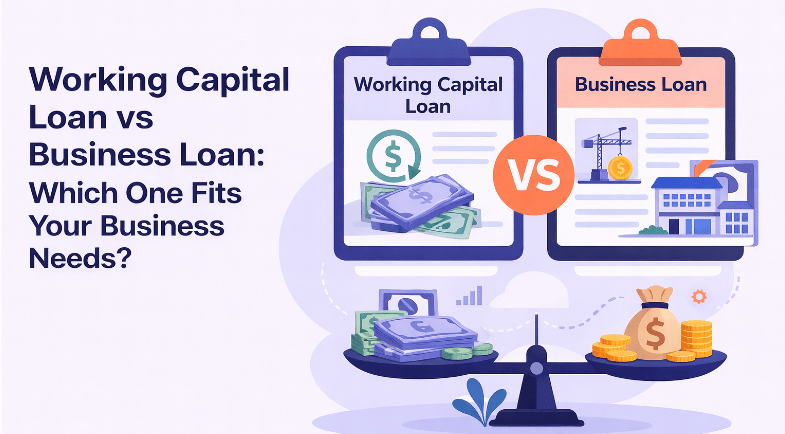
Working Capital Loan vs Business Loan: Which One Fits Your Business Needs?
If you’re an Australian business owner – whether you run a local café, a growing manufacturing facility, or a multi-state construction firm – you know that cash flow isn’t just important; it’s the lifeblood of your operation.
Recent research commissioned by CommBank found that nearly 80% of Australian small to medium businesses (SMBs) have experienced an impact on their cash flow in the last 12 months. So when growth opportunities knock, or unexpected pressure arises at the worst possible time, external funding often becomes part of the solution. That leads to a core question: should you pursue a Working Capital Loan or a more traditional Business Loan?
To someone new to commercial finance, the two can sound interchangeable. They both provide capital, right? Yes – but they’re built to solve very different problems. Choosing the wrong tool can mean higher costs, repayment stress, and missed opportunities.
At Efficient Capital, we believe that clear, straight-talking advice is non-negotiable. In this guide, we’ll break down how each product works, use real Australian scenarios, and show you where Working Capital Loan vs Business Loan really matters for your business.
The Heart of the Matter: Purpose Dictates Product
The most important difference between these two funding options comes down to one simple idea: time horizon.
A Working Capital Loan is a short-term solution for immediate operational needs. It’s there to bridge the gap between paying your bills (outflow) and being paid by your customers (inflow). Done well, working capital finance helps you maintain liquidity through the bumps. External guides describe working capital loans as short-term facilities designed to fund day-to-day operating expenses rather than long-term investments, which aligns with how Australian lenders position these products. You can explore how Efficient Capital structures its Working Capital Loan and working capital finance solution.
A Business Loan, on the other hand, is a strategic, longer-term funding tool. It’s used for larger, capital-intensive purchases that are intended to generate revenue or efficiency over many years – for example, equipment, vehicles, or even commercial property. This is closer to the structured, long-term capital planning approach described in Efficient Capital’s Capital Accumulation Plans, which focuses on building durable value over time. Understanding this “short-term vs long-term” distinction is the first step in matching the right finance product to your business goal.
Deep Dive: The Agile Solution for Operational Flow
Before we get into the mechanics of a Working Capital Loan, it helps to be clear about what “working capital” actually is.
Working capital is the difference between your current assets (cash, receivables, inventory) and current liabilities (payables, short-term debt). Put simply, it’s the money you have available to cover day-to-day expenses and keep the lights on.
When this buffer is tight or negative, you have a liquidity crunch – and in Australia, that’s a common story. An analysis of ASIC data shows that 47% of failed Australian SMEs cite poor cash flow as a primary cause of insolvency. That’s almost half of all failures linked back to cash flow management issues.
What Working Capital Loans Typically Fund
The purpose of this type of funding is usually cyclical, recurring, or short-lived. Common uses include:
- Inventory stock-up: Buying extra stock ahead of a busy seasonal period – for example, a coastal retailer gearing up for summer holidays, or a nursery stocking plants for spring.
- Payroll management: Paying staff on time when a large client invoice is running a couple of weeks late.
- Supplier payments: Leveraging early payment discounts from suppliers to improve long-term margins.
- Tax obligations: Covering GST or BAS payments without disrupting daily operations.
A Working Capital Loan Example: The Builder’s Dilemma
Consider this classic scenario.
A reputable Sydney construction business secures a $500,000 project. They need to spend $150,000 on materials, subcontractor deposits and labour in the first 30 days. The first client’s progress payment, however, won’t arrive until day 60. That 30-day gap is a working capital problem. The business needs fast, flexible funds to cover the upfront costs without stalling the job.
In this case, an agile Working Capital Loan – often structured as an unsecured short-term facility or line of credit – is a strong match. The owner can draw what they need, complete the work, and then repay the facility as soon as the client’s payment lands.
Typical Features of a Working Capital Loan
Because these facilities focus on speed and liquidity rather than long-term asset security, they commonly feature:
- Shorter terms: Often between 6 and 18 months.
- Unsecured or lightly secured structures: Frequently, no hard property collateral is required; security may be limited to personal guarantees or business assets.
- Speed to funding: Approval and funding can often happen within days, which is critical when you’re facing an immediate cash flow squeeze.
Deep Dive: The Strategic Power of a Business Loan
If a Working Capital Loan is the scalpel for everyday cash flow, a Business Loan (often a term loan) is the tool for bigger, strategic moves.
A Business Loan is typically used to acquire assets or fund initiatives expected to deliver value over several years. This is the kind of capital that upgrades your business’s earning power, capacity, or efficiency. Many Australian lenders frame term loans in exactly this way – as finance for specific, one-off purchases or projects that pay back over time.
What Business Loans Typically Fund
These are usually large-scale, non-recurring investments aimed at long-term growth:
- Asset acquisition: Buying a new $300,000 specialised machine, a fleet of delivery vehicles, or upgraded IT infrastructure.
- Commercial property: Purchasing a factory, warehouse, or office instead of leasing.
- Expansion or acquisition: Funding a major fit-out, second site, or acquiring a smaller competitor.
- Long-term refinancing: Consolidating several smaller, high-cost debts into one structured SME business loan with clearer terms.
Because the loan term is commonly three, five, seven or even ten years, the lender is taking on more long-term risk. That’s why traditional Business Loans usually require security – often in the form of property or high-value business assets.
The Reserve Bank of Australia’s October 2025 Small Business Economic and Financial Conditions Bulletin notes that small businesses often report challenges obtaining finance, with many citing strict requirements, interest rates, processing times and the need to provide property or personal assets as collateral.
Key Features of a Business Loan
- Longer terms: Typically 3 to 10+ years, amortised over a fixed period.
- Secured: Usually backed by collateral such as commercial property, residential property, or equipment.
- Structured repayments: Fixed, regular principal and interest instalments, which make budgeting more predictable.
- Lower interest rates (relative to unsecured short-term finance): Because the loan is secured and repaid over a longer period, pricing is usually sharper than for a short-term unsecured facility.
For more details on how lenders compare secured and unsecured Business Loan options, Efficient Capital’s secured loans guide is a useful reference point.
Working Capital Loan vs Business Loan: The Critical Differences
When you put the two side by side, the contrast is sharp.
Feature |
Working Capital Loan |
Business Loan (Term Loan) |
| Core purpose | Managing short-term operational cash flow and liquidity. | Funding long-term strategic growth and asset acquisition. |
| Time horizon | Short (around 6–18 months). | Long (typically 3–10+ years). |
| Security | Often unsecured or secured against receivables/inventory. | Typically secured by property, equipment or other tangible collateral. |
| Repayments | Can be flexible – daily, weekly or aligned to cash flow cycles. | Fixed principal and interest repayments, usually monthly or quarterly. |
| Speed | Fast – some approvals and funding can occur within 24–72 hours. | Slower – often weeks, once valuations and security documentation are complete. |
| Cost | Usually, higher interest rates are due to shorter terms and a higher risk to the lender. | Generally, lower interest rates are available thanks to security and longer repayment periods. |
Australian Scenarios: Choosing the Right Tool
SMEs make up the bulk of the Australian business landscape. According to the Australian Banking Association’s SME Lending Report, SMEs accounted for 98% of all Australian businesses in 2022 when measured by staff employed.
More recently, the ABA has noted that new lending to SMEs nearly doubled between 2020 and 2024, with SMEs borrowing $154 billion in 2024, up from $80 billion in 2020. That growth in borrowing underlines just how important it is to choose the right kind of facility.
Here’s how three very different businesses might approach the choice.
Scenario A: The Seasonal Wine Distributor (Working Capital Loan)
- The challenge: An Adelaide-based wine distributor sees a sharp spike in orders leading up to Christmas. They must purchase and store significant stock in September, but won’t receive payment from retailers until January. The shortfall – say $100,000 over three months – is predictable but temporary.
- The solution: A Working Capital Loan. This is a textbook cash-flow smoothing problem. The facility covers stock and warehousing costs through the peak period, then is repaid once receivables come in after Christmas. The focus is liquidity, not asset building.
Scenario B: The Growing Fabrication Shop (Business Loan)
- The challenge: A Melbourne fabrication workshop secures two major government infrastructure contracts. To handle the workload, they need a specialised CNC plasma cutter worth $450,000, with an expected working life of 15 years.
- The solution: A Business Loan or asset finance facility. This is a long-term investment in a depreciating but productive asset that will generate revenue for years. The loan term should roughly align with the asset’s useful life, and the machine itself will often act as security.
You can see how equipment and asset finance are structured for Australian businesses by Efficient Capital.
Scenario C: The unexpected equipment failure (the hybrid need)
- The challenge: A regional bakery’s main dough mixer fails, and replacing it costs $25,000. They have $10,000 in savings and need $15,000 immediately to avoid shutting down production.
- The solution: This sits in the grey zone between day-to-day cash flow and long-term investment. Because the amount is relatively modest and timing is critical, an agile Working Capital Loan may be the most practical way to get back up and running quickly. If the cost were considerably higher, a structured Business Loan or equipment finance facility would become more suitable.
Align Finance With the Future You’re Building
The decision between a Working Capital Loan and a traditional Business Loan really comes down to two questions:
- What are you trying to achieve?
- How long will you need the money before it pays you back?
If your goal is to smooth the everyday ebb and flow of cash – covering payroll, buying stock ahead of confirmed orders, or bridging a short timing gap on invoices – an agile Working Capital Loan is usually the better fit.
If you’re focused on long-term growth, strategic expansion, or the acquisition of major, revenue-generating assets, a structured Business Loan generally offers the stability and lower long-term cost that kind of commitment deserves.
In other words, your finance strategy should match the rhythm of your business.
If you’re weighing up Working Capital Loan vs Business Loan options and aren’t sure which structure fits your cash flow, asset base and risk appetite, it’s worth getting specialist guidance rather than guessing. We at Efficient Capital work with Australian SMEs across industries to find the right mix of working capital finance, term loans and other facilities so you can spend less time wrestling with paperwork and more time growing your business.
You can learn more or start a conversation with our team at Efficient Capital.