

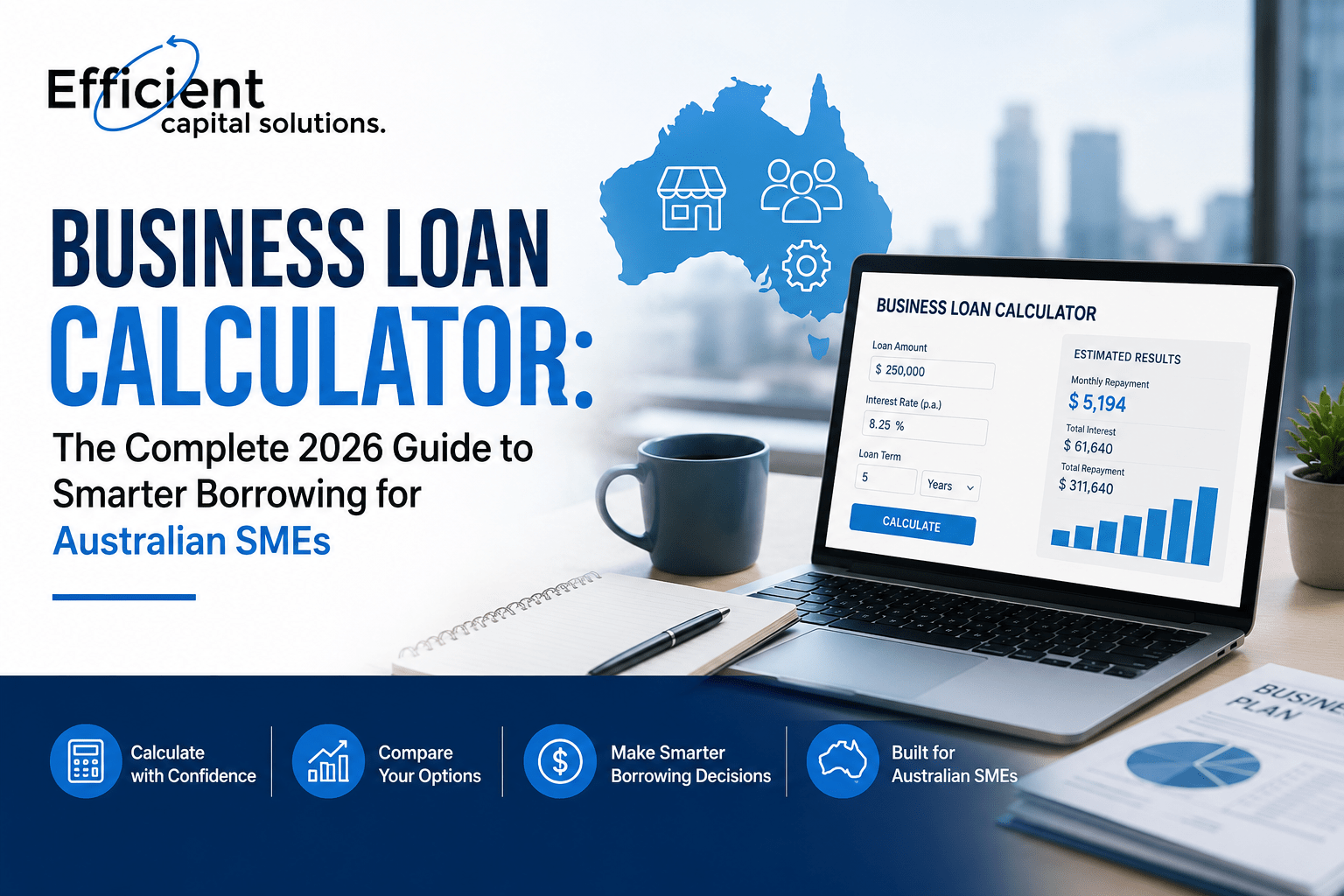
Business Loan Calculator: The Complete 2026 Guide to Smarter Borrowing for Australian SMEs
Stop Guessing. Start Calculating.
Every Australian business owner has been there — sitting across from a bank manager, or scrolling through a lender’s website at midnight, trying to figure out whether this loan actually makes sense. The repayments feel manageable today, but what about in six months when the rate adjusts? What if you borrowed $50,000 more? What if you shortened the term by a year?
That’s exactly what a business loan calculator is built to answer.
A business loan calculator is one of the most powerful (and most underused) tools available to small and medium-sized business owners in Australia. It lets you model different scenarios — varying your loan amount, interest rate, and repayment term — before you commit to a single dollar of debt. In 2026, as lending conditions shift alongside RBA rate movements, using a business loan calculator isn’t just smart. It’s essential.
This guide will walk you through everything you need to know: how a business loan calculator works, what inputs to use, how to compare multiple loan offers, and — most importantly — how to turn those numbers into a funding decision you can actually feel confident about.
What Is a Business Loan Calculator and Why Does It Matter?
A business loan calculator is a digital tool that uses three key variables — loan amount, interest rate, and loan term — to estimate your regular repayment obligations. Depending on the tool, it may also calculate:
- Total interest paid over the life of the loan
- Total cost of borrowing (principal + interest)
- Monthly, fortnightly, or weekly repayment breakdowns
- Amortisation schedules showing how each payment splits between interest and principal
For Australian business owners, a small business loan calculator helps answer the single most important question before borrowing: Can my business actually afford this?
Without a calculator, you’re relying on rough estimates and gut feel. With one, you have data. And data-driven borrowing decisions are how thriving Australian businesses separate themselves from ones that buckle under debt they didn’t fully understand.
How a Business Loan Calculator Works: The Core Formula
Most business loan calculators use a standard amortisation formula. While you don’t need to memorise the maths, understanding the logic helps you use the tool more effectively.
The monthly repayment on a standard business loan is calculated as:
M = P × [r(1+r)ⁿ] / [(1+r)ⁿ – 1]
Where:
- M = monthly repayment
- P = loan principal (the amount you borrow)
- r = monthly interest rate (annual rate ÷ 12)
- n = total number of repayments (loan term in months)
A business loan payment calculator applies this formula automatically when you plug in your figures. What once required a financial degree to compute now takes about thirty seconds online.
The key insight: small changes in interest rate or loan term have a surprisingly large impact on total repayments. A business loan calculator makes those differences visible — and that visibility is where smart borrowing decisions are made.
5 Key Inputs You Need Before Using a Business Loan Calculator
A business loan calculator is only as accurate as the information you feed it. Before you start modelling, gather these five figures:
1. Loan Amount
How much do you actually need? Be precise. Overborrowing increases your debt burden unnecessarily; underborrowing means you might need to apply again sooner. Use your business loan calculator to test your target amount and a range either side.
2. Interest Rate
Australian business loan rates in 2026 vary widely — from around 6.5% p.a. for secured loans from major banks, to 15–25% p.a. for unsecured short-term lending. Your rate will depend on your credit profile, trading history, security offered, and the lender’s risk appetite. If you have multiple offers, a small business loan calculator lets you compare them directly.
3. Loan Term
Standard business loan terms range from 1 to 5 years for unsecured loans, and up to 15–25 years for secured commercial property loans. A longer term reduces monthly repayments but increases total interest paid. A small business loan repayment calculator will show you this trade-off clearly.
4. Repayment Frequency
Most Australian lenders offer monthly, fortnightly, or weekly repayments. Choosing fortnightly instead of monthly can shave months off your loan term and save significant interest — your business loan payment calculator can model this for you.
5. Fees and Charges
Establishment fees, monthly account-keeping fees, and early repayment penalties can add thousands to the true cost of a loan. Some business loan calculators include a field for fees; if yours doesn’t, factor them in manually when reviewing your total cost of borrowing.
Using a Business Loan Calculator to Compare Loan Offers
This is where a business loan calculator delivers its greatest value in 2026: comparing multiple loan offers side by side.
Consider a real-world scenario. You’ve received two business loan offers:
Offer A: $200,000 at 8.5% p.a. over 5 years Offer B: $200,000 at 7.9% p.a. over 5 years
Plugging both into a small business loan calculator:
| Offer A | Offer B | |
| Monthly Repayment | $4,106 | $4,045 |
| Total Interest Paid | $46,360 | $42,700 |
| Total Repayment | $246,360 | $242,700 |
Offer B saves you approximately $3,660 in interest over the loan term — money that stays in your business. Without a business loan calculator, these two offers might have felt roughly equivalent. With one, the better deal is obvious.
Now extend the comparison further. What if Offer B had a $2,500 establishment fee that Offer A didn’t? Your business loan calculator reveals that the total cost advantage of Offer B narrows to around $1,160. Is that still worth choosing a lender with fewer services or a less flexible structure? Possibly — but now you’re making an informed choice.
This is the power of a small business loan comparison calculator: it transforms confusing loan documents into clear, comparable numbers.
Business Loan Calculator: How Much Can I Borrow?
One of the most common questions Australian business owners ask is: business loan — how much can I borrow?
A business loan calculator gives you one part of the answer — what repayment amount looks manageable given your cash flow. But lenders look at borrowing capacity differently. They typically assess:
- Debt Service Coverage Ratio (DSCR) Lenders want to see that your net operating income comfortably covers your loan repayments — usually by a ratio of at least 1.25:1. Use your small business loan calculator to model your expected monthly repayment, then check it against your average monthly net income.
- Business Revenue and Trading History Most lenders require 1–2 years of business financials. Higher and more consistent revenue means higher borrowing capacity. Some non-bank lenders will consider 6 months of bank statements.
- Security Offered Secured business loans — backed by property, equipment, or other assets — generally allow you to borrow more at lower rates. Unsecured loans are faster but smaller. Your business loan calculator can model both scenarios.
- Credit Profile Both personal and business credit scores influence how much you can borrow and at what rate. A stronger profile unlocks better rates — which your business loan calculator can show you translates into thousands of dollars in savings.
- Industry and Business Type Some industries carry higher perceived lending risk. A café with seasonal cash flow may face different borrowing limits than a logistics firm with long-term contracts.
As a rough starting point: many Australian lenders will approve business loans up to 10–15% of annual turnover for unsecured lending, and significantly more for secured facilities. Run these scenarios through your small business loan repayment calculator to see what the repayments would look like before approaching a lender.
Types of Business Loans You Can Model With a Business Loan Calculator
A business loan calculator can be applied to virtually any loan structure. Here’s how it maps to the most common Australian business financing options:
Term Loans
The most straightforward type. You borrow a fixed amount, repay it over a set term with regular payments. This is where a business loan payment calculator is most directly applicable.
Business Line of Credit / Overdraft
Interest is calculated only on the drawn balance, which varies over time. A standard business loan calculator won’t model this perfectly, but it can give you a useful baseline if you assume an average drawn amount.
Equipment Finance
Fixed-term, often secured against the equipment itself. A small business loan calculator works well here — simply enter the equipment cost as your loan amount.
Invoice Finance / Debtor Finance
More complex — fees are usually charged as a percentage of invoice value rather than an interest rate. Requires a specialist calculator, but you can approximate with a business loan calculator using the effective annualised rate.
Commercial Property Loans
Longer terms (up to 25 years), typically at lower rates. A small business loan repayment calculator with a 15–25 year term field is ideal for modelling these.
Common Mistakes When Using a Business Loan Calculator
A business loan calculator is a powerful tool, but it’s worth knowing where borrowers go wrong:
Mistake 1: Using the Advertised Rate, Not the Comparison Rate The comparison rate includes fees and charges alongside the interest rate, giving a truer picture of total cost. Always use the comparison rate in your small business loan calculator inputs where possible.
Mistake 2: Ignoring Cash Flow Seasonality A repayment that’s comfortable in January might be a stretch in July if your business has seasonal revenue. Model your repayments against your lowest monthly income, not your average.
Mistake 3: Only Modelling One Scenario Use your business loan calculator to test at least three scenarios: your target loan amount, 20% more, and 20% less. This gives you a range of outcomes and clarifies how much buffer you have.
Mistake 4: Forgetting About Rate Changes If you’re considering a variable-rate loan, model your repayments at the current rate and at a rate 1.5–2% higher. Australian interest rates can move — your small business loan payment calculator should reflect that risk.
Mistake 5: Treating the Calculator as the Final Answer A business loan calculator gives you data. A finance broker gives you strategy — matching that data to the right lender, structure, and terms for your specific situation.
What the Numbers Don’t Tell You: When to Speak to a Finance Broker
A business loan calculator can tell you what a loan will cost. It can’t tell you:
- Which lenders are most likely to approve your application
- Whether your loan structure is tax-efficient
- How to present your financials to maximise borrowing capacity
- Which lender will provide the fastest approval when you need capital urgently
- Whether a secured or unsecured structure makes more sense for your cash flow
This is where working with an experienced finance broker makes a material difference.
At Efficient Capital Solutions, our team of commercial finance brokers has helped hundreds of Australian businesses access the right funding — not just the most obvious funding. We work across a panel of major banks and specialist lenders, which means we can place your application with the lender most likely to approve it at the terms your business deserves.
A business loan calculator is where the conversation starts. Our brokers are where it ends — with a funding solution that works for your business, not just a spreadsheet.
Step-by-Step: How to Use a Business Loan Calculator Effectively
Follow this process to get the most out of any business loan calculator:
Step 1: Define your funding purpose Equipment purchase? Working capital? Business acquisition? The purpose shapes which loan type is most appropriate, and therefore which inputs to use in your small business loan calculator.
Step 2: Determine your realistic loan amount Based on your cash flow, assets, and trading history — not your wish list.
Step 3: Research current market rates In mid-2026, secured business loan rates from Australian major banks are broadly in the 7–10% p.a. range; non-bank lenders offer more flexibility but often at higher rates. Use realistic figures in your business loan payment calculator.
Step 4: Test multiple terms Run the same loan amount at 2, 3, and 5 years. See how the monthly repayment and total interest change. This is one of the most valuable exercises a small business loan repayment calculator enables.
Step 5: Build in a buffer Whatever repayment your business loan calculator returns, ensure your monthly business income exceeds it by at least 25–30%. This buffer protects you against slow months and unexpected expenses.
Step 6: Compare at least three lenders Don’t stop at one offer. A small business loan calculator lets you model and compare multiple offers in minutes — use it.
Step 7: Engage a broker before applying Multiple loan applications in a short window can hurt your credit score. A broker helps you identify the right lender before you apply, protecting your credit profile.
Business Loan Calculator: Frequently Asked Questions
How accurate is a business loan calculator? Very accurate for fixed-rate term loans. The calculator applies the same formula lenders use to calculate repayments. The main variable is fees, which need to be added separately to get total cost of borrowing.
Can I use a small business loan calculator for a line of credit? You can use it as an approximation. Assume an average utilisation amount and treat it as a fixed loan. For precise modelling of revolving credit, speak to a broker.
Does using a business loan calculator affect my credit score? No. A business loan calculator is a planning tool — it doesn’t involve any credit enquiry. Only a formal loan application triggers a credit check.
What’s the difference between a business loan calculator and a small business loan repayment calculator? They’re typically the same tool. The terminology varies between lenders and websites, but the core function — calculating repayments from loan amount, rate, and term — is identical.
How do I calculate how much I can borrow for a business loan? Start with your average monthly net income, multiply by 12 to get annual income, and consider that most lenders apply a DSCR of 1.25–1.5x. Your monthly repayment (as shown by your business loan calculator) should generally not exceed 40–50% of your average monthly net income. For a precise assessment, speak to a broker.
What interest rate should I enter into the business loan calculator? Use the comparison rate where possible, as it includes fees. If you only have an advertised rate, add an estimated 0.3–0.8% for typical fee structures to get a more accurate total cost picture.
The Bottom Line: A Business Loan Calculator Is Just the Beginning
A business loan calculator is the smartest starting point for any Australian business considering external finance in 2026. It brings clarity to what can feel like a confusing and opaque process — transforming raw loan offers into clear, comparable numbers you can actually act on.
But numbers alone don’t get business loans approved. Strategy does. Relationships do. Knowing which lender is right for your business, your industry, and your financial profile does.
That’s where Efficient Capital Solutions comes in.
Ready to Go Beyond the Calculator?
At Efficient Capital Solutions, we combine the analytical rigour of a business loan calculator with the expertise of experienced commercial finance brokers who know the Australian lending market inside out.
Whether you’re looking for a business loan to fund expansion, purchase equipment, manage cash flow, or acquire a competitor — our team will help you find the right structure, the right lender, and the right terms.
Contact Efficient Capital Solutions today → Explore Business Loan Options → Speak to a Commercial Finance Broker →
Don’t just calculate your loan. Get it right, with Efficient Capital.
Efficient Capital Solutions is a full-service finance brokerage based in Sydney, Australia, offering business loans, commercial property loans, equipment finance, and working capital solutions across Greater Sydney and nationally. Our team of experienced finance brokers works with a panel of major banks and specialist lenders to find the right funding solution for your business.