

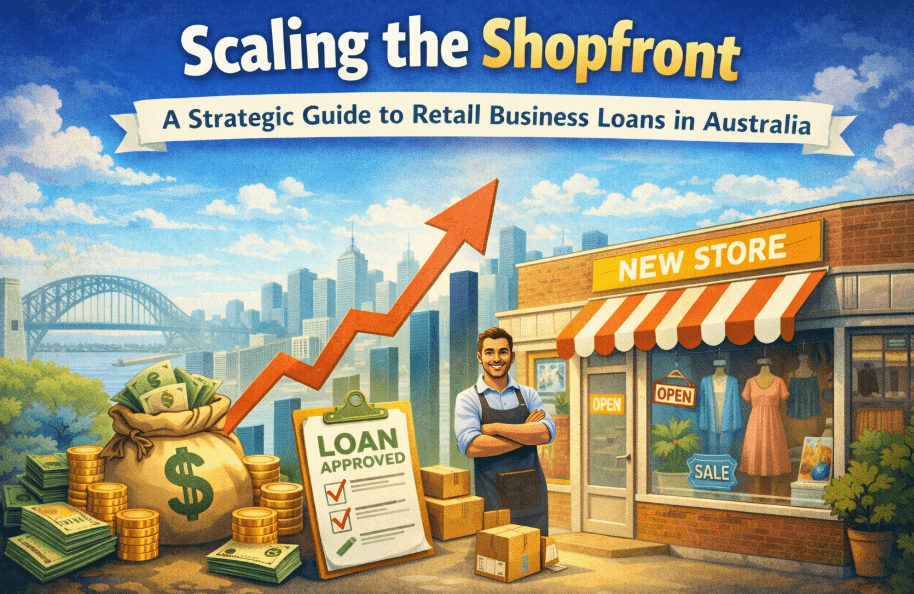
Retail Business Loans in Australia: How to Fund Expansion
Running a retail business in Australia today can feel like navigating shifting currents. Consumer expectations are evolving, operating costs continue to fluctuate, and growth opportunities often arrive faster than available cash flow. For many retailers across Greater Sydney, there comes a point where steady operations are no longer enough. Demand is growing, expansion opportunities appear within reach, yet working capital remains tied up in inventory, staffing, or existing lease commitments.
This is often the moment when businesses begin transitioning from a single shopfront into a scalable retail operation. Making that leap requires more than ambition. It requires access to the right funding structure at the right time. Understanding how retail business loans work and how retail business finance in Australia supports sustainable expansion becomes a critical part of long-term growth planning.
In this guide, we explore the landscape of retail business finance in Australia, how to evaluate business loans for retail stores, and how a well-structured retail expansion loan can support growth without placing unnecessary pressure on margins.
The Current Retail Landscape: Why Now?
Before diving into the “how,” let’s look at the “why.” Despite the whispers of economic tightening, Australian consumers are remarkably resilient. Recent data from the shows that total retail turnover reached $37,906.6 million, marking a 1.2% month-on-month increase and a solid 4.9% growth year-on-year.
Interestingly, specific sectors like clothing, footwear, and personal accessories are seeing trend figures around $3,160.4 million. This tells us one thing: Australians are still spending, but they are gravitating toward brands that offer better experiences, faster delivery, and more physical touchpoints.
To capture this market, retailers are increasingly looking toward external funding. Nearly 109,000 SME loans worth $16.5 billion were issued as of mid-2024. This indicates a high level of confidence among business owners who are using these funds to renovate, relocate, or double their footprint.
Understanding Your Options for Retail Business Loans
When you start looking for retail business loans, it’s easy to get overwhelmed by the sheer variety of products. However, in the Australian market, these generally fall into three functional buckets.
- Working Capital Loans
Retail is seasonal. You might need a cash injection to stock up before the Christmas rush or the end-of-financial-year sales. Working capital loans are designed to bridge the gap between paying suppliers and receiving customer payments. These are often unsecured, meaning you don’t need to put up your family home as collateral, which speeds up the approval process significantly.
- Equipment and Fit-out Financing
If your expansion involves opening a second location, the “bricks and mortar” costs can be daunting. From high-end POS systems to custom shelving and refrigeration, the capital outlay is front-heavy. Specialist business loans for retail stores often include “chattel mortgages” or leasing options, where the equipment itself serves as the security for the loan.
- Strategic Expansion Loans
A retail expansion loan is usually a larger, long-term facility. This is what you use when you are moving into a larger warehouse, acquiring a competitor, or launching a massive e-commerce overhaul. APRA lending aggregates show business lending continuing to expand across non-financial sectors, including retail.
Identifying the right bucket for your funding is only the first half of the battle. The real magic happens when you align these financial products with a rigorous, data-backed strategy that satisfies even the most conservative Australian lenders.
Navigating Retail Business Finance Australia: The Strategic Approach
Success in retail business finance in Australia isn’t just about getting a loan; it’s about getting the right loan. The Australian Banking Association has noted in their Small Business Lending Reports that while lending remains accessible, the criteria have become more sophisticated. To ensure you are positioned as a low-risk, high-reward candidate for lenders, consider the following:
- The Debt-to-Income Ratio: Lenders want to see that your retail turnover can comfortably cover your repayments even during a quiet month.
- The Power of Data: Use your ABS industry-specific turnover tables to benchmark your performance. If your store is outperforming the national average growth of 4.9%, highlight this in your application. It proves your business model generates superior returns.
- The “Why” Behind the Buy: Don’t just ask for $200,000. Show that $200,000 will be used to purchase inventory that has a historical 40% margin, effectively turning that loan into a profit engine.
Positioning your business as a safe bet is about demonstrating you have the systems to manage them. Once you’ve mastered the art of the application, the next step is mapping out exactly how that capital hits the ground to build your empire.
How to Structure a Retail Expansion Loan for Success
When you apply for a retail expansion loan, you are essentially selling a piece of your future success to a lender. At Efficient Capital, we often see that the most successful retailers are those who treat their loans as a tool rather than a debt. Here is a logical roadmap for your expansion:
Phase 1: The Feasibility Audit
Check the Lending Indicators from the ABS to see current fixed-term volumes. This gives you an idea of the market temperature. Is it a borrower’s market?
Phase 2: Choosing the Facility
Do you need a lump sum, or would a line of credit be better? For retail, a line of credit is often superior because you only pay interest on what you use. That is perfect for managing the ebb and flow of stock arrivals.
Phase 3: Integration
Once the retail business loans are approved, the focus shifts to execution. Use the funds to secure prime real estate or invest in omnichannel technology that merges your physical store with your online presence.
A well-structured loan is the bridge between where your shop is today and where you want it to be next year. However, even with the perfect roadmap, the retail landscape is littered with hidden obstacles that can trip up even the most seasoned store owners.
Common Pitfalls in Retail Financing
Even with the best intentions, retail owners often fall into a few common traps:
- Underestimating Soft Costs
A retail expansion loan covers the rent and the stock, but does it cover the 20% increase in your electricity bill or the additional staff training hours? Always borrow slightly more than your perfect world estimate.
- Poor Timing
Don’t wait until your cash reserves are at zero to look for retail business finance in Australia. Lenders prefer to lend to businesses that are already healthy. Apply for funding while your balance sheet is strong.
- Ignoring Commercial Options
Many retailers default to their Big Four personal bank. However, commercial financing options often provide more flexibility, bespoke repayment schedules that match your seasonal peaks, and faster settlement times.
Avoiding these traps is what separates a retail business that merely survives from one that dominates its local market. When you sidestep the common errors of timing and narrow-minded banking, you clear the path for a seamless transition from a single storefront to a flourishing enterprise.
The Human Element: Retail is About People
While we talk a lot about stats and data, retail remains the most “human” of all industries. Your expansion is about reaching more people in your community. Whether you’re providing the latest fashion or essential groceries, your growth contributes to the local economy.
The ABA’s 2021 Small Business Lending Report noted that during the height of the pandemic, over $50 billion in SME loans were deferred to support businesses. This shows that the Australian financial ecosystem is designed to be a partner to the retail sector, not just a spectator.
Your Next Step Toward Growth
The Australian retail market is currently in a “sweet spot” of steady growth and high consumer engagement. If you have been sitting on the fence about expanding, the data suggests that the window of opportunity is wide open.
Securing retail business loans is the fuel your business needs to move from a single-location operation to a multi-channel brand. By understanding the nuances of retail business finance in Australia and selecting the right business loans for retail stores, you are investing in the future of your brand.
Ready to take the leap? Whether you need a small injection for inventory or a comprehensive retail expansion loan, the team at Efficient Capital is here to help you navigate the complexities of the Australian lending market. Let’s turn your retail vision into a commercial reality.