

Refinance Car Loan in Australia: When It Makes Sense & How Much You Can Save
Whether you are cruising down the Great Ocean Road or navigating the daily commute through Sydney’s M4, your car is more than just a tool—it is often one of the biggest financial commitments you will make. But for many Australians, the excitement of driving off the lot eventually fades into the reality of monthly repayments that feel just a little too heavy.
In today’s economic climate, where the cost of living is a frequent topic of conversation around the dinner table, looking for ways to trim your overhead is simply smart business. One of the most overlooked strategies for putting money back in your pocket is to Refinance Car Loan agreements that no longer serve your financial goals.
Understand when it makes sense to switch, the data behind why Australians are making the move, and exactly how much you can save by opting for a car loan refinance.
The Australian Car Finance Landscape in 2025
To understand why a Refinance Car Loan is such a popular topic right now, we have to look at the sheer scale of borrowing in Australia. According to the ABS Lending Indicators for the September Quarter 2025, Australians borrowed a staggering $9.3 billion in new fixed-term personal loans. Out of that total, approximately $4.9 billion was specifically for “road vehicles,” including both new and used cars.
With billions of dollars in circulation, it is no surprise that many of those loans weren’t set up with the best possible terms for the long haul. Many borrowers take the first finance offer they get at the dealership because they want the car that day. However, dealership finance can often come with higher interest rates or “doc fees” that inflate the total cost of the loan.
Data suggests that the average vehicle loan in Australia is roughly $34,827. With an average personal loan interest rate sitting around 13.87% p.a., the interest costs can accumulate rapidly. This is where the decision to refinance vehicle loan structures becomes a powerful tool for financial recovery.
Why Should You Consider a Refinance Car Loan?
Refinancing isn’t just about chasing a lower number; it’s about aligning your debt with your current life circumstances. Here are the most common scenarios where a refinance car loan makes the most sense:
1. Your Credit Score Has Improved
If you bought your car when your credit history was a bit “thin” or after a period of financial instability, you likely received a higher interest rate. If you have spent the last 12 to 24 months making on-time payments, your credit score has likely improved, making you eligible for a much more competitive auto car loan refinance rate.
2. Market Rates Have Dropped
Interest rates are rarely static. If the RBA or market conditions have led to a general decrease in lending rates since you signed your original contract, you could be paying “yesterday’s prices” for today’s money.
3. You Need to Avoid the “Default Trap”
The Australian Securities and Investments Commission (ASIC) recently conducted a 2025 car finance review that revealed some sobering statistics. They found that nearly half of all consumers who defaulted on their car finance did so within the first six months.
Even more alarming, of the vehicles that were repossessed and sold, almost 90% of consumers still owed more than half of their original loan amount. If you feel yourself struggling to keep up with repayments, choosing to refinance your auto loan into a more affordable monthly commitment can be the difference between keeping your car and facing repossession.
How Much Can You Actually Save?
The question everyone asks is: “Is the paperwork worth the effort?” The data suggests a resounding yes. Let’s look at some real-world examples.
Let’s look at it through a car loan refinance example from Finder: a borrower with a 4-year, $15,000 car loan at a 12% interest rate would typically pay around $527 per month. By choosing to refinance car loan terms to a 3-year loan at 7%, the monthly payment drops to $464.
That might only look like $63 a month, but over the life of the loan, that is a total saving of $2,268. That is a significant amount of money that could be better spent on insurance, maintenance, or your mortgage.
A similar study found that borrowers who refinanced cut their monthly payments by an average of $142, saving $1,346 on total loan costs. Interestingly, Millennials saved the most, averaging $150 in monthly reductions. This shows that across different age groups and loan types, an auto car loan refinance is a viable way to improve cash flow.
Furthermore, Savvy Finance highlights an example where a borrower with a remaining balance of $13,400 at 10% interest refinanced to a 3-year loan at 5.34%. This simple move saved them approximately $40 per month and $1,440 over the remaining term. Whether your savings are $40 or $150 a month, the cumulative effect on your household budget is undeniable.
The Refinance Effect: A Practical Savings Example
This table illustrates a hypothetical scenario based on a borrower with a $25,000 balance remaining on a 4-year term, switching from a high-rate unsecured personal loan to a competitive secured car loan rate.
Loan Feature |
Current High-Rate Loan |
New Refinanced Loan |
Your Potential Savings |
| Interest Rate | 12.50% p.a. | 6.50% p.a. | 6.00% p.a. rate reduction |
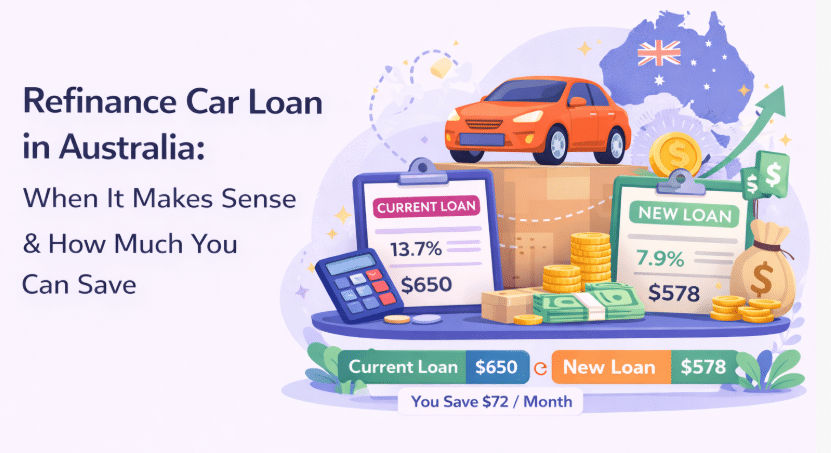
| Monthly Repayment | $665 | $593 | $72 extra in your pocket every month |
| Total Interest Payable | $6,920 | $3,464 | $3,456 total interest saved over 4 years |
Note: Figures are illustrative and rounded for clarity. Actual savings will depend on your specific loan amount, credit profile, and lender criteria.
When Is the Best Time to Refinance?
While the savings are clear, timing is everything. To successfully Refinance Car Loan agreements, you should check for a few key factors:
- The Age of the Vehicle: Most lenders have a limit on how old a car can be (often 7 to 10 years by the end of the loan term) to qualify for a secured refinance vehicle loan.
- The “Break Costs”: Some older car loan contracts have exit fees or “early termination fees.” You need to ensure the interest savings from the car loan refinance outweigh the cost of leaving your current lender.
- Equity in the Car: If you owe $30,000 on a car that is only worth $20,000 (known as being “underwater” or having negative equity), it can be harder to refinance your auto loan. However, some specialist lenders may still be able to help you restructure.
Once you’ve ticked those boxes and confirmed that the numbers fall in your favour, the path forward is surprisingly straightforward. Unlike the initial purchase, where you had to juggle vehicle inspections, registration transfers, and the excitement of a test drive, the administrative side of a switch is much leaner. If you’ve determined that the timing is right, here is how you can move from the ‘thinking’ phase into actual savings.
The Process: How to Refinance Your Auto Loan
Refinancing is often simpler than the initial purchase because you already have the asset. Here is how you should approach it:
- Gather Your Current Loan Details: Find your current payout figure, your current interest rate, and the remaining term.
- Check Your Credit Score: Knowing your score allows you to target the right lenders.
- Compare the Market: Don’t just go to your current bank. Using a broker like Efficient Capital can help you scan multiple Australian lenders to find a Refinance Car Loan that fits your specific profile.
- Calculate the Savings: Use the figures we discussed—look at the monthly repayment and the total interest over the life of the loan.
- Apply and Payout: Once approved, your new lender will typically pay out your old loan directly, and you will begin your new, lower repayments.
While the steps above are simple enough to follow, the biggest hurdle for most Australians is often just getting started. It is easy to look at a monthly repayment and think, ‘I’ll deal with that next month,’ but as we have seen from the shifting landscape of Australian finance, procrastination has a literal price tag. Taking action now ensures you aren’t left behind as market conditions evolve.
Don’t Wait Until It’s Too Late
The Finder report on car loan trends suggests that getting car finance might actually become harder in the near future as lenders tighten their criteria following ASIC’s reviews. This makes “now” an opportune time to lock in a better deal.
Choosing to Refinance Car Loan structures isn’t just a “budget hack”—it’s a proactive financial move. Whether you want to pay off your debt faster or simply need more breathing room in your monthly budget, a car loan refinance offers a pathway to financial freedom.
At Efficient Capital, we understand the Australian market and the nuances of auto car loan refinance options. We help you navigate the jargon, avoid the pitfalls of high-exit fees, and ensure that when you decide to refinance vehicle loan terms, you are genuinely coming out ahead.
Your car shouldn’t be a source of financial stress. By taking the time to refinance your auto loan, you can enjoy the drive knowing your money is working as hard as you do. Ready to see how much you could save? It might be the best financial detour you ever take.